
SciMed Education
Additive Elements in Lubricating Oils Using EDXRF According to ASTM D7751
Introduction
The determination of additive elements in new lubricating oils by Energy Dispersive X-Ray Fluorescence (EDXRF) is a well-established analytical approach for production control and formulation verification. The ASTM D7751 method defines a robust framework for quantifying key elements such as phosphorus, sulphur, calcium, zinc, and molybdenum using XRF spectrometry.
EDXRF provides a direct, multi-element analytical pathway that aligns well with the compositional complexity of modern lubricant formulations, offering an efficient alternative to more labour-intensive techniques.
Role of Additive Elements in Lubricating Oils
Modern lubricants are engineered systems in which base oils are combined with carefully controlled additive packages. These additives serve distinct functional roles:
• Anti-wear and extreme pressure (EP) additives: typically containing Phosphorus (P), Sulphur (S), and Zinc (Zn)
• Detergents and dispersants: often based on Calcium (Ca), Magnesium (Mg), or Barium (Ba)
• Friction modifiers and performance enhancers: including Molybdenum (Mo) compounds
• Corrosion inhibitors and stabilizers: sometimes involving additional trace elements
Accurate quantification of these elements is critical for formulation consistency, regulatory compliance, and product specification adherence. ASTM D7751 specifically targets these additive-derived elements in fresh oils, where concentrations are controlled and known.
Overview of ASTM D7751
ASTM D7751 is designed for the determination of additive elements in unused lubricating oils using EDXRF spectrometry. It applies to a wide range of lubricant types, including engine oils, gear oils, and industrial formulations.
KEY ANALYTES
Sample Preparation
Calibration Approach
Performance Criteria
Typical elements covered include:
• Phosphorus (P)
• Sulphur (S)
• Calcium (Ca)
• Zinc (Zn)
• Magnesium (Mg)
• Molybdenum (Mo)
• Barium (Ba)
• Chlorine (Cl) (in certain formulations)
Sample preparation is intentionally minimal:
• Homogenisation of the oil sample is essential
• Direct introduction into an XRF sample cup (typically ~4 g)
• Use of a suitable film (e.g., polypropylene) for containment
• Optional helium purge for improved light element sensitivity
This simplicity is a defining advantage of EDXRF for lubricant analysis.
ASTM D7751 supports:
• Empirical calibration using matrix-matched standards
• Alpha corrections to compensate for interelement effects
• Verification with independent reference materials
Calibration standards must be representative of the lubricant formulation space to ensure accuracy across varying base oil compositions.
The method defines requirements for:
• Precision (repeatability and reproducibility)
• Calibration linearity
• Detection capability appropriate to additive concentration ranges
Performance is dependent on both calibration design and instrument capability.

Why Use EDXRF for Lubricating Oil Analysis?
Multi-Element Capability
EDXRF simultaneously quantifies multiple additive elements in a single measurement, making it highly efficient for routine laboratory workflows.
Minimal Sample Preparation
Unlike ICP-OES, which requires dilution or digestion, EDXRF enables direct analysis of oil samples, reducing:
• Sample handling errors
•Preparation time
• Consumable usage
Speed and Throughput
Typical measurement times are on the order of minutes, enabling high-throughput operation in QA/QC environments.
Comparison to ICP-OES and Wet Chemistry
Technique | Strengths | Limitations |
EDXRF | Minimal prep, multi-element, fast | Matrix effects require careful calibration |
ICP-OES | High sensitivity, broad element range | Requires dilution/digestion, higher operational complexity |
Wet chemistry | Element-specific accuracy | Time-consuming, single-element focus |
For routine ASTM D7751 compliance, EDXRF provides a balanced combination of speed, accuracy, and operational simplicity.
Technical Considerations in EDXRF Lubricant Analysis
Matrix Effects
Lubricating oils present a complex organic matrix that influences X-ray absorption and enhancement that can impact measured intensities.
Mitigation strategies include:
• Matrix-matched calibration standards
• Alpha coefficient corrections
• Fundamental Parameters (FP) modelling
Mitigation strategies include:
• Matrix-matched calibration standards
• Alpha coefficient corrections
• Fundamental Parameters (FP) modelling
Inter-element Effects
Spectral overlaps and secondary excitation effects must be addressed, particularly for:
• P and S in hydrocarbon matrices
• Ca and Zn in high-additive formulations
Modern software performs peak deconvolution and correction automatically, but calibration design remains critical.
Fundamental Parameters vs Empirical Calibration
• Empirical calibration: preferred for ASTM D7751 compliance due to traceability and robustness
• Fundamental Parameters (FP): useful for screening, method development, and extending calibration ranges
Hybrid approaches—combining FP with product-specific matching libraries—can improve accuracy across formulation families.
Light Element Detection
Elements such as Mg, P, and S require:
• Optimized excitation conditions
• Reduced air absorption (helium atmosphere)
• High detector sensitivity
Instrument configuration plays a significant role in achieving reliable results for these analytes.

What EDXRF Instrumentation is suitable for ASTM D7751 Compliance?
An EDXRF spectrometer suitable for ASTM D7751 should include:
• High-performance detector (e.g., silicon drift detector)
• Stable X-ray source with appropriate excitation conditions
• Capability for indirect or polarised excitation
• Software supporting empirical calibration and FP modelling
• Controlled atmosphere (helium) for light elements
Instrument configuration plays a significant role in achieving reliable results for these analytes, and one of the best available solutions is the Rigaku NEX CGII EDXRF.
Rigaku NEX CGII EDXRF for ASTM D7751
The Rigaku NEX CGII is designed to meet the analytical and operational requirements of ASTM D7751.
Relevant technical characteristics include:
• Indirect excitation with polarisation to reduce background and improve sensitivity
• 50 W Pd-anode X-ray tube providing stable excitation across relevant elements
• Large-area silicon drift detector (SDD) enabling high count rates and spectral resolution
• Helium purge capability for improved light element detection
• QuantEZ software supporting both empirical calibration and FP-based approaches
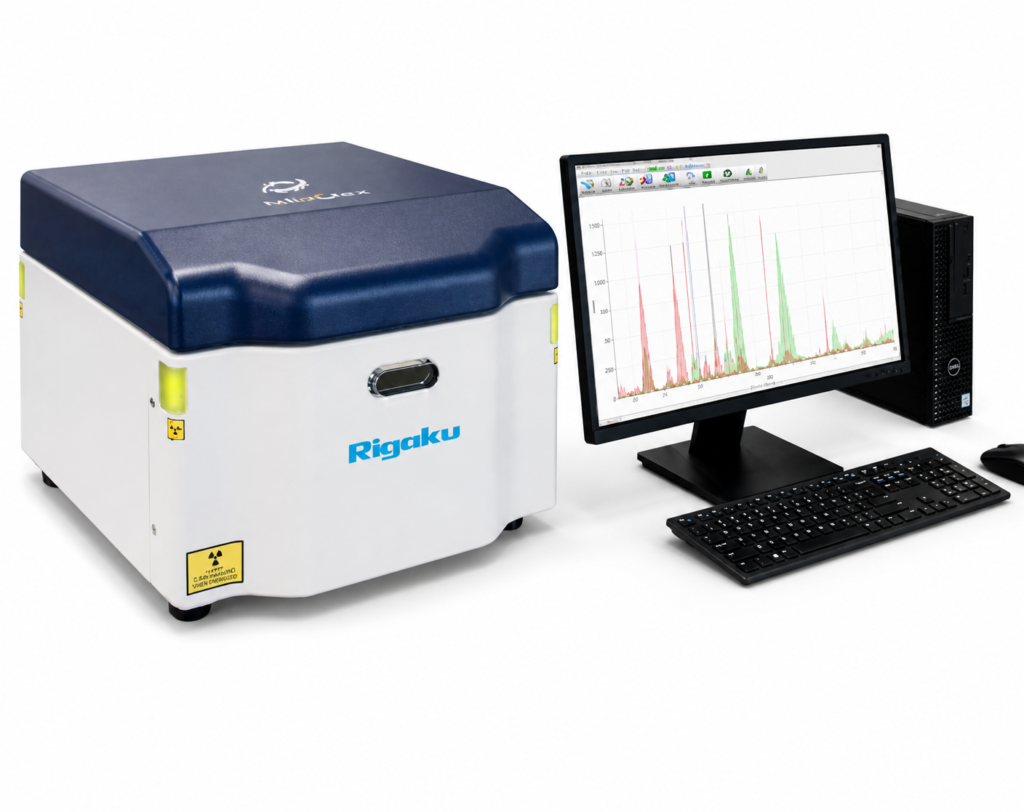

The system also supports:
• Multi-position sample handling for batch analysis
• Flexible measurement time optimisation depending on formulation
• Integration of matching libraries to align XRF results with reference methods
Application data demonstrate effective calibration across typical additive concentration ranges and strong agreement with reference assay values when appropriate calibration strategies are employed.
A copy of Rigaku EDXRF Application note #3144 – Analysis of Lube Oils by ASTM D7751 can be issued upon request
Summary
EDXRF is a proven and efficient technique for the determination of additive elements in new lubricating oils under ASTM D7751. Its strengths—minimal preparation, multi-element capability, and rapid analysis—make it particularly well-suited to laboratory environments requiring reliable and repeatable results.
Careful attention to calibration strategy, matrix effects, and instrument configuration is essential to achieving accurate measurements. Systems such as the Rigaku NEX CGII provide the technical capabilities necessary to meet these requirements while supporting practical laboratory workflows.
What to do Next?
Explore how EDXRF can streamline your lubricant analysis workflows. Contact our team to discuss ASTM D7751 requirements or find the right system for your lab.
Page FAQ's
ASTM D7751 is used to determine additive elements in unused lubricating oils using EDXRF. It enables quantification of elements such as phosphorus, sulphur, calcium, zinc, and molybdenum for formulation control and quality assurance.
EDXRF is well suited because it provides rapid, multi-element analysis with minimal sample preparation. It allows direct measurement of oil samples, reducing preparation time while maintaining reliable analytical performance.
Matrix effects in lubricating oils can influence X-ray absorption and signal intensity. Using calibration standards that closely match the formulation ensures accurate quantification across different base oil compositions and additive packages.
- EDXRF can complement or replace ICP-OES for routine additive analysis, particularly where high throughput and minimal preparation are required. However, ICP-OES may still be preferred for ultra-trace analysis or applications requiring very low detection limits.
Contact Us Today
We take great pleasure in assisting you and ensuring you get a prompt response to your questions
Live chat opening hours Mon – Fri 9:15 to 16:30 (UK Time)