
SciMed Education
Crude Oil Vapour Pressure Measurement with Floating Piston Cylinder (FPC) and RVP Pro
In Summary
Accurately measuring the vapour pressure of crude oil helps operators understand volatility and ensure safe handling. An inter‑laboratory study on the ASTM D6377 method showed that measurements performed with a pressurised floating piston cylinder (FPC) preserve volatile “light ends” and produce higher and more accurate vapour pressure readings compared with bottle filling, even though the repeatability figures are similar. Because bottle filling allows volatile components to escape before analysis, vapour pressure readings can be 10 kPa lower (up to 20 per cent difference) than when an FPC is used. Using the FPC in combination with the RVP Pro analyser therefore ensures that results are both repeatable and accurate.
What is mixing calorimetry used for?
Mixing calorimetry is used to investigate the energetics of processes that occur when materials interact. This includes chemical reactions, adsorption of gases or liquids onto solids, dissolution processes and the mixing of liquids.
By measuring the heat released or absorbed during these interactions, scientists can determine enthalpy changes and gain insight into reaction mechanisms.
What does the inter‑laboratory study show about crude oil vapour pressure measurement?
An inter‑laboratory “round‑robin” study conducted in 2003 evaluated the accuracy of vapour pressure measurements performed at 37.8 °C with a vapour‑to‑liquid ratio (V/L) of 4:1.The study investigated two sample introduction techniques: pressurised filling using a floating piston cylinder (FPC) and filling from bottles.
It found that, while the repeatability figures (r) for the two methods were similar, the measured vapour pressures differed significantly because samples introduced from bottles lost light ends. The results therefore highlighted the importance of preserving volatile components during sample preparation in order to obtain accurate vapour pressure data.

Why are light ends lost when not using a floating piston cylinder (FPC)?
Crude oil contains a range of volatile compounds that can evaporate if the sample is exposed to ambient conditions. When a bottle is opened for sampling, the light ends flash off and are no longer present in the sample introduced into the analyser. The application note explains that crude oils measured without a pressurised FPC may have lost light ends and therefore produce lower vapour pressure readings.
In contrast, an FPC maintains the sample under pressure during transfer to the RVP Pro instrument, preventing the loss of volatile components and ensuring that the measured vapour pressure reflects the true composition of the crude
How do repeatability and reproducibility compare with or without a pressurised floating piston cylinder?
During the round‑robin study, the ASTM D6377 method was used to measure the vapour pressure of crude oils at 37.8 °C and a V/L ratio of 4:1. When samples were introduced via an FPC, the repeatability (r) of the method was 2.48 kPa and the reproducibility (R) was 4.26 kPa. When the same method was applied to samples filled via a tube from a bottle, the repeatability was 2.29 kPa and the reproducibility increased slightly to 5.26 kPa.
For comparison, measurements performed according to ASTM D323 under the same conditions gave a reproducibility of 9 kPa. These results show that, although repeatability figures are comparable for both sample introduction methods, the D6377 method with FPC offers lower variability than the older D323 technique and provides more reliable results.

What differences in vapour pressure readings occur when using FPC versus bottle filling?
The application note provides example measurements on six crude oil samples using the D6377 method at 37.8 °C and a V/L ratio of 4:1. When the samples were introduced with an FPC, the vapour pressure conversion ratio (VPCR) values ranged from about 42 kPa to 117 kPa and the corresponding calculated Reid vapour pressure equivalent (RVPE) ranged from roughly 35 kPa to 98 kPa.
When the same samples were filled from bottles, the VPCR and RVPE values were consistently lower. On average, the difference between FPC and bottle measurements was approximately 10 kPa or up to 20 per cent for crude oils containing volatile components. For crude oils with little or no volatile content, the difference was much smaller. These findings demonstrate that bottle filling can produce significantly lower vapour pressure readings, leading to underestimation of volatility.
What are VPCR and RVPE, and why are conversion factors used?
The vapour pressure conversion ratio (VPCR) is the vapour pressure measured by the RVP Pro analyser under ASTM D6377 conditions. The Reid vapour pressure equivalent (RVPE) is calculated from the VPCR to provide a value comparable to traditional Reid vapour pressure.
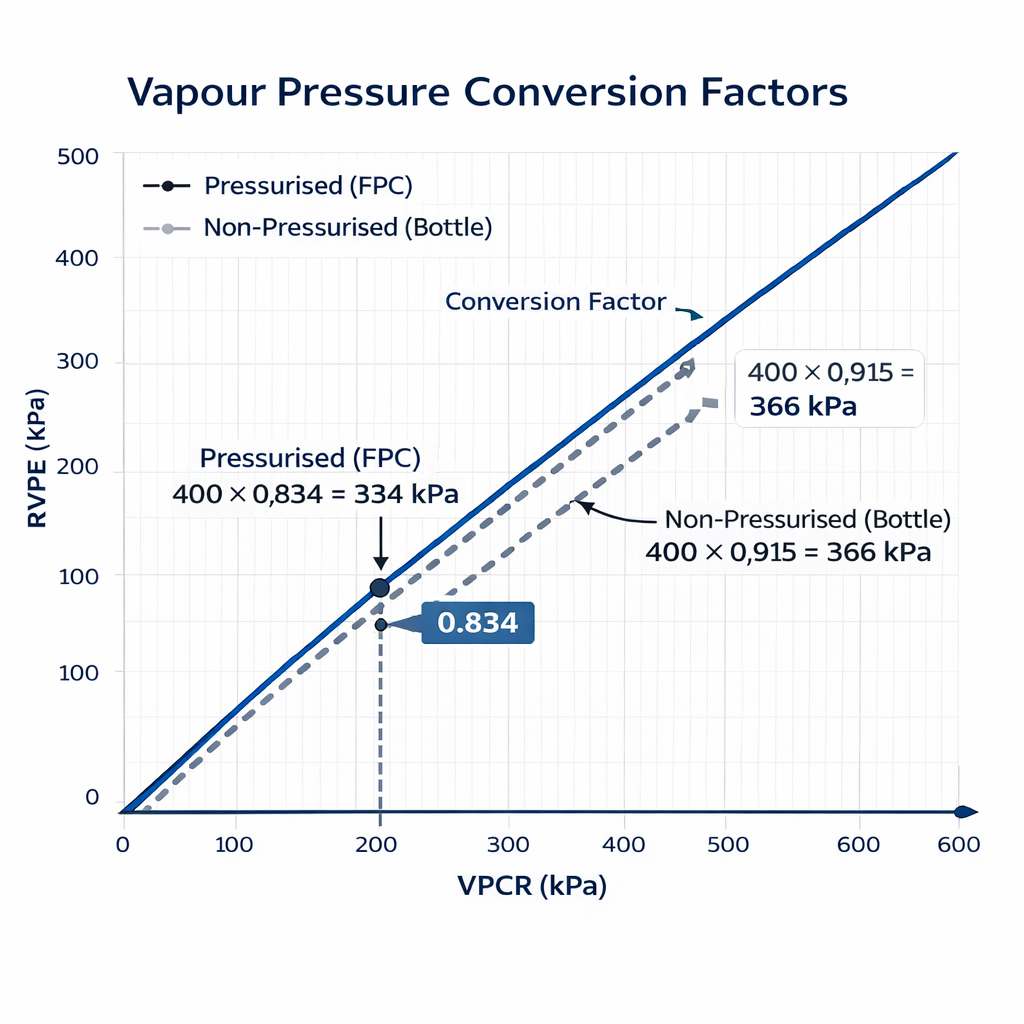
The application note reports that, when measuring pressurised crude oils with an FPC, the RVPE is obtained by multiplying the VPCR \u2064\uf4 value by 0.834. For non‑pressurised crude oils introduced from bottles, a higher factor of 0.915 is used. These different conversion factors compensate for the loss of light ends in bottle filling and illustrate that pressurised sampling gives a more representative vapour pressure measurement.
Why is the ASTM D6377 method preferred over ASTM D323 for crude oil vapour pressure measurement?
ASTM D323 was originally developed for petroleum products but is less suitable for heavy, viscous samples like crude oil. The application note notes that the ASTM D6377 method, which utilises an automatic mini‑vapour pressure tester such as RVP Pro, is more accurate than D323 regardless of whether an FPC is used.
D6377 measurements with an FPC provide reproducibility of around 4.26 kPa, while D323 measurements yield a reproducibility of 9 kPa. These figures indicate that D6377 delivers more consistent results and, when combined with pressurised sample introduction, better preserves volatile components.
When should you use a floating piston cylinder for crude oil measurements?
The data in the application note demonstrate that crude oil samples containing significant volatile components produce much higher vapour pressure readings when introduced with an FPC than when filled from bottles. In these cases, the difference can be up to 20 per cent. By comparison, crude oils with little or no volatile content show only minor differences between the two methods.
It is therefore recommended that analysts use a floating piston cylinder whenever possible to maintain light ends and ensure that vapour pressure measurements are both repeatable and accurate.
What to do Next?
Speak to our specialists about accurate crude oil vapour pressure measurement and discover how pressurised sampling with FPC can improve your results.
Page FAQ's
The floating piston cylinder keeps the sample under pressure during transfer to the analyser, preventing the loss of volatile light ends. Using it ensures that vapour pressure measurements reflect the true volatile composition of the crude oil
According to the application note, for crude oils that contain volatiles the difference between FPC measurements and bottle measurements is about 10 kPa, or up to 20 per cent. For samples with little or no volatiles, the difference is much smaller
ASTM D6377, when combined with a floating piston cylinder, provides more accurate and reproducible vapour pressure measurements than ASTM D323. D6377 is considered the preferred method for crude oil because it better preserves volatile components and yields lower reproducibility values.
The conversion factor from VPCR to RVPE is smaller (0.834) for pressurised samples because the vapour pressure measurement closely reflects the true composition of the crude. For non‑pressurised samples introduced from bottles, the factor is larger (0.915) to compensate for the loss of volatile components.
Contact Us Today
We take great pleasure in assisting you and ensuring you get a prompt response to your questions
Live chat opening hours Mon – Fri 9:15 to 16:30 (UK Time)