
SciMed Education
How can trace and major elements in powdered milk be analyzed using ICP-MS?
In Summary
ICP-MS enables accurate, high-sensitivity analysis of major, trace, and toxic elements in powdered milk within a single run, delivering reliable quality control across a wide concentration range using a robust and cost-efficient workflow.
What is the challenge?
Quality control of milk and milk products requires determining major, trace, and toxic elements across a wide concentration range.
What is the challenge?
A universal ICP-MS method using the PlasmaQuant MS enables quantification of all relevant elements in a single analysis run with high sensitivity, precision, and robustness. Using half the amount of argon as other ICP-MS systems.
What is powdered milk and why analyze it?
Powdered milk is a widely used dairy product with a long shelf life, suitable for infants, adults, and industrial applications.
- Provides essential minerals, vitamins, and trace elements
- Requires strict quality control to ensure safety and nutritional value
- Toxic elements such as Cd, As, Hg, and Pb must be monitored

How are samples prepared and analyzed?
Sample Preparation
• Dilution: 0.2 g powdered milk in 20 mL deionized water
• Microwave digestion: 0.2–0.5 g powdered milk digested with HNO₃ and H₂O₂, diluted to 50 mL.
Calibration
• Calibration solutions prepared in 1% HNO₃
• Trace elements: 0.1–50 μg/L
• Matrix elements: 1–50 mg/L
Instrumentation
• PlasmaQuant MS ICP-MS with ASPQ 3300 autosampler
• Standard sample introduction and internal standards (Sc, Y, Rh, Ir) added online
Method Overview
• Integrated Collision Reaction Cell removes polyatomic interferences
• ADD10 detector allows simultaneous quantification of major, trace, and ultratrace elements
• High sensitivity and robustness allow accurate results for all elements in one run
What parameters are used for evaluation?
Parameters used for evaluation include plasma gas flow, auxiliary gas, nebulizer gas, and RF power, along with dwell time, scans per replicate, and number of replicates, as well as sampling depth and sample introduction control to prevent deposition, and collision or reaction cell settings such as H₂, He, or no gas to reduce interferences.
CLICK TO VIEW IMAGE
What results were achieved?
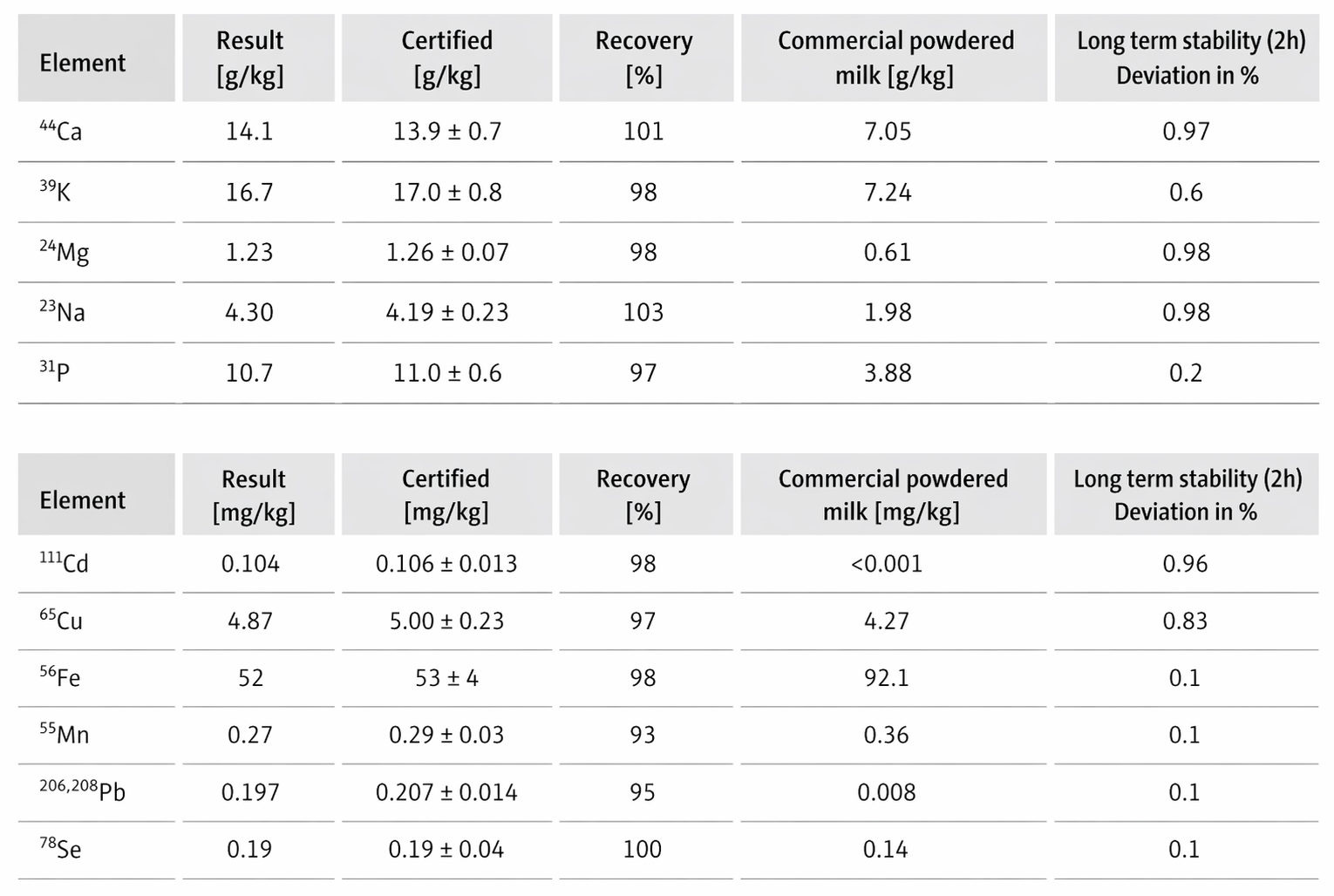
• Certified reference material ERM®-BD151 verified method accuracy:
• Recoveries for major elements: 97–103%
• Recoveries for trace elements: 93–100%
• Commercial powdered milk showed results in agreement with CRM and product labels
• Long-term stability confirmed over 2 hours of continuous analysis
Why is this method effective?
• Covers a wide concentration range in a single run
• Accurate and robust even for trace and toxic elements
• Minimal sample preparation with reliable microwave digestion or dilution
• High sensitivity, interference removal, and long-term stability
• Cost-efficient, routine-ready method for quality control laboratories using half the amount of argon compared to other ICP-MS

What to do Next?
Ready to improve your powdered milk analysis? Enhance your workflow with reliable ICP-MS detection by requesting product details, speaking with an expert, scheduling a demo, or contacting SciMed to learn more.
Page FAQ's
Trace and major elements in powdered milk can be analysed using ICP-MS by combining simple sample preparation with high-sensitivity detection. Using systems such as the PlasmaQuant MS, laboratories can quantify elements across a wide concentration range in a single analytical run with excellent precision and robustness.
Elemental analysis is essential to ensure powdered milk meets safety and nutritional standards. While key minerals contribute to nutritional value, toxic elements such as cadmium, arsenic, mercury, and lead must be monitored to ensure compliance with food safety regulations and protect consumer health.
Powdered milk contains both major and trace elements across a wide concentration range, making accurate quantification challenging. In addition, complex sample matrices can introduce interferences, requiring a method that can handle both high and low concentration elements simultaneously without compromising accuracy.
ICP-MS systems such as the PlasmaQuant MS use an integrated collision reaction cell to remove polyatomic interferences. By using gases such as hydrogen or helium, the system ensures interference-free detection, while internal standards correct for signal variations, resulting in accurate and reliable measurements.
Contact Us Today
We take great pleasure in assisting you and ensuring you get a prompt response to your questions
Live chat opening hours Mon – Fri 9:15 to 16:30 (UK Time)