
SciMed Education
Measuring Batteries Using the Right Setup for Accurate Electrochemical Impedance Spectroscopy (EIS) Tests
In Summary
How you connect a battery during EIS testing really matters. Even tiny resistances from cables, connectors, or holders can distort the results. They can hide the true equivalent series resistance (ESR) of the cell.
Direct contact, four terminal (Kelvin) holders for CR2032 coin cells and cylindrical 18650 cells minimise extra impedance and inductance, producing highly reproducible data. The result is cleaner, more repeatable data. You can measure ESR more accurately, often several milliohms lower, and avoid false conclusions.
Battery measurements can be misleading – why does the experimental setup matter?
Accurate battery testing starts with a stable experimental setup. Many factors affect performance – electrolyte, electrode materials, temperature, voltage range, and current rating. Standard two-point battery holders only provide two contacts, so the sense leads also measure the impedance of the cables, connectors, and contacts, not just the battery itself.
Even using short leads, these extra resistances make the measured impedance larger than the battery’s true internal impedance. This can give low precision measurements and lead to false conclusions.
Soldering tabs to the battery allows four‑terminal measurements and better accuracy. However, separating all leads without shorting the battery is difficult and the setup must be dismantled to swap cells. This makes testing slow and inconvenient.

Two wires vs four wires – what is the difference in battery impedance measurements?
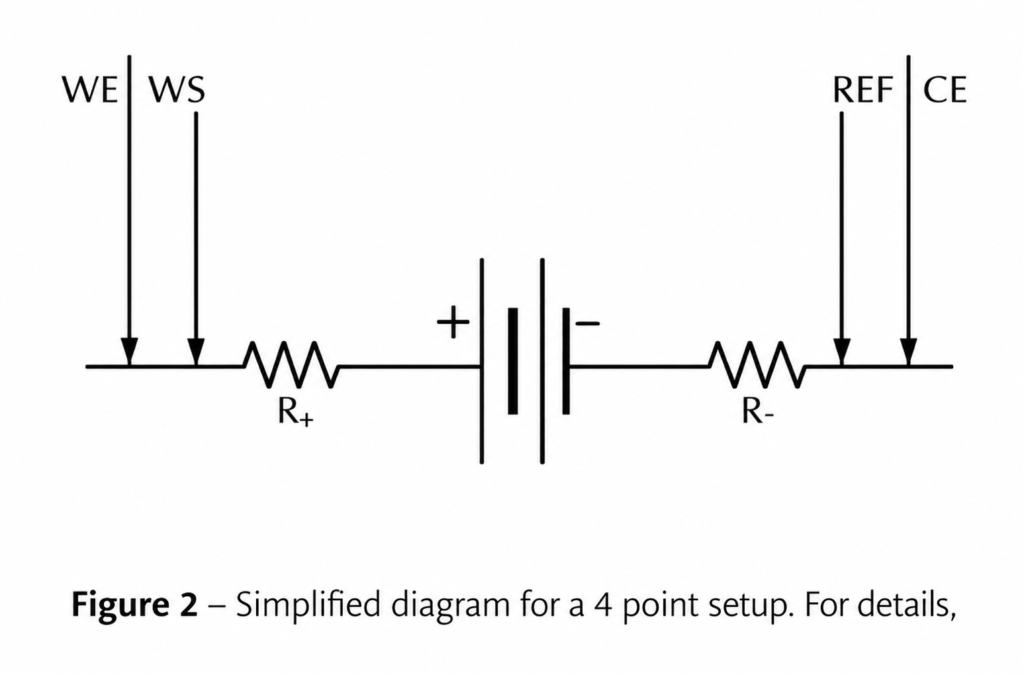
In a two‑point setup, the working and working sense leads share one contact and the counter and reference leads share another contact. This means the measured impedance includes resistance from cables and connectors, and the battery.
A standard four‑point (Kelvin) setup improves this by separating the current and sense leads, but they will still share contact tabs on the battery.
Direct‑contact four‑point holders go one step further. Each battery contact is split so the current and sense leads touch the battery electrodes directly. This makes the measurement much cleaner. The leads are held close together on a printed circuit board to reduce inductance. Colour‑coded connectors ensure stable, repeatable connections. Because all four leads are fully separated, extra resistance from cables and connectors is almost eliminated. This makes it easy to compare multiple cells accurately without rewiring the setup each time!

When does four terminal measurement really matter for batteries?

When testing high-capacity lithium ion cells or low impedance devices, even milliohms of extra resistance can distort results. The measurement setup plays a bigger role than many people realise.
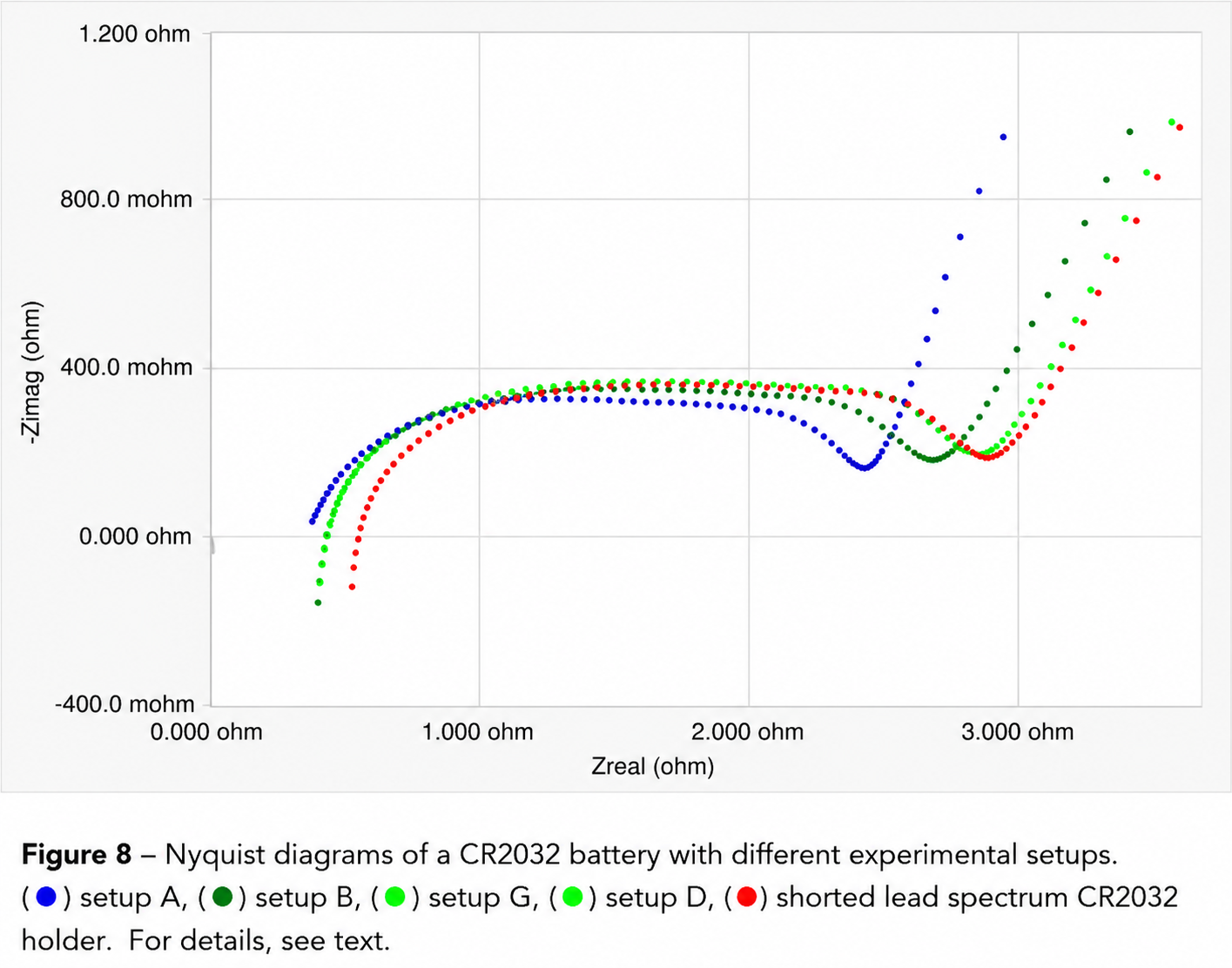
Tests comparing different setups clearly show this effect. In “shorted lead” experiments, the leads are connected through a metal block to mimic a dummy cell. At high frequencies inductance dominates, and careful cable layout can reduce it. At low frequencies, however, the system hits its minimum measurable impedance. At that point, resistance from cables and connectors really matters.
This becomes obvious when you look at equivalent series resistance (ESR) from electrochemical impedance spectroscopy (EIS) measurements. Optimised four‑terminal setups give much lower and far more accurate ESR values. In contrast, two‑point setups can greatly inflate the apparent resistance, sometimes by over 100%.
The takeaway is clear. Four‑terminal measurements are essential for low‑impedance devices or when comparing similar cells. Even small setup differences can introduce real errors. Direct‑contact configurations remove these extra impedances and deliver consistent, reliable results. That reproducibility is crucial when evaluating materials, where tiny performance differences make all the difference.
Practical tips for reliable battery testing and impedance spectroscopy
For the best results, use a direct‑contact four‑terminal setup whenever you can. Make sure the current and sense leads are fully separated. Keep the leads close together and as short as possible to reduce inductance.
Use low‑inductance cables for sensitive measurements. Place the sense leads as close to the battery terminals as you can. Small details like this make a big difference.
Try not to dismantle or reconnect the setup between tests. Every change can add variability. Let batteries stabilise before measuring so conditions stay consistent.
Finally, remember that your measurement system has limits. Very low impedance values or low frequencies can still affect accuracy if you’re not careful.

What to Do Next?
Achieving reliable battery measurements requires more than just a good potentiostat – the connection to the cell is just as critical. Direct contact four terminal measurement setups provide precise and reproducible impedance data.
If you are evaluating battery materials or performance, consider improving your measurement setup to eliminate hidden sources of error. Speak to SciMed to find the right solution for your application.
Page FAQ's
Two point holders force the working and sense leads to share the same connection, so the measured impedance includes resistance from cables and connectors. This can significantly increase the apparent resistance of the battery.
In a standard Kelvin setup the sense leads may still share contact points with current carrying leads. Direct contact setups separate these completely, ensuring measurement is taken directly at the battery electrodes.
If you are measuring low impedance cells or comparing similar batteries, small resistances from leads can distort results. Four terminal setups minimise these errors.
Changes in connections between measurements introduce variations in contact resistance. A fixed and stable setup improves consistency.
Equivalent series resistance represents internal losses within a battery and is critical for evaluating performance, efficiency and degradation.
Contact Us Today
We take great pleasure in assisting you and ensuring you get a prompt response to your questions
Live chat opening hours Mon – Fri 9:15 to 16:30 (UK Time)