
SciMed Education
Combustion Ion Chromatography for PFAS and Halogen Analysis
In Summary
PFAS and halogen analysis is becoming increasingly important across environmental, industrial, waste, and water-testing laboratories. Combustion ion chromatography (CIC) provides an effective workflow for PFAS screening and total halogen determination by combining automated sample preparation, pyrohydrolytic combustion, and ion chromatography detection for fluoride and other inorganic anions.
What are PFAS and why is PFAS screening important?
Per- and polyfluoroalkyl substances (PFAS) are a large group of fluorinated compounds widely used in industrial processes and consumer products because of their water-, oil-, and chemical-resistant properties. Due to their persistence and resistance to degradation, PFAS can accumulate in the environment and are now the focus of increasing global regulatory attention.
Because thousands of PFAS compounds exist, laboratories often use screening methods that measure total organically bound fluorine rather than targeting only individual compounds. Adsorbable organically bound fluorine (AOF) analysis provides a practical screening approach for identifying PFAS contamination in environmental and industrial samples.
Methods such as ASTM D7359 and other combustion ion chromatography workflows support fluorine and halogen determination in complex matrices where trace-level screening is required.
How does combustion ion chromatography support PFAS and halogen analysis?
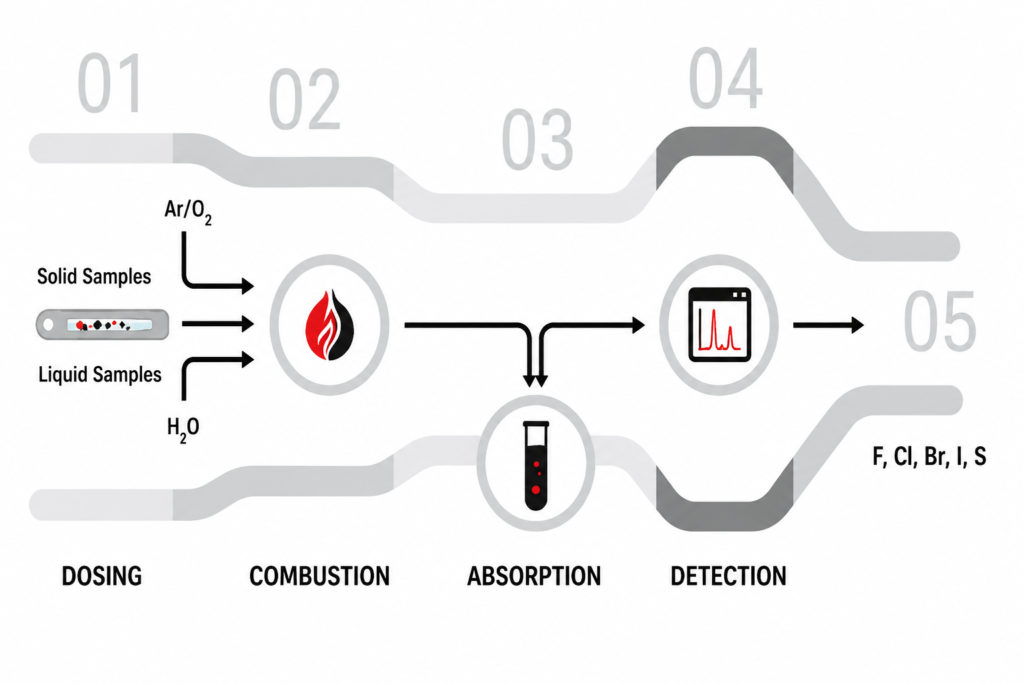
Combustion ion chromatography combines high-temperature combustion with ion chromatography detection to measure fluorine, chlorine, bromine, sulfur, and other inorganic anions following sample digestion.
In a typical workflow, organofluorine or organohalogen compounds are first captured or prepared before undergoing pyrohydrolytic combustion at elevated temperatures in an oxygen-rich atmosphere. During combustion, organically bound fluorine is converted into hydrogen fluoride, while chlorine and bromine compounds are converted into their corresponding hydrogen halides.
These combustion gases are absorbed into an aqueous solution before analysis using ion chromatography. This allows laboratories to perform sensitive fluoride and halogen measurements across a wide range of matrices, including waters, environmental solids, waste materials, fuels, and industrial samples.
The approach is particularly valuable for:
• PFAS screening workflows
• AOF and AOX determination
• Total fluorine analysis
• Halogen determination in solids
• Environmental contamination monitoring
• Waste and recycling analysis
How does AOF sample preparation support PFAS screening?
AOF analysis begins with enrichment of organofluorine compounds onto activated carbon columns. During this process, water samples are passed through activated carbon while inorganic fluorides remain largely unretained. This enables selective enrichment of organically bound fluorine compounds, including PFAS.
Following enrichment, the activated carbon is combusted under pyrohydrolytic conditions to convert organofluorine species into hydrogen fluoride for ion chromatography analysis.
The workflow provides a practical and cost-effective method for PFAS screening where total fluorine determination is more appropriate than targeted single-compound analysis.
Because the method measures total organically bound fluorine, it can identify fluorinated contamination that may otherwise be missed using targeted PFAS-only approaches.
How does the ICprep system support combustion ion chromatography workflows?
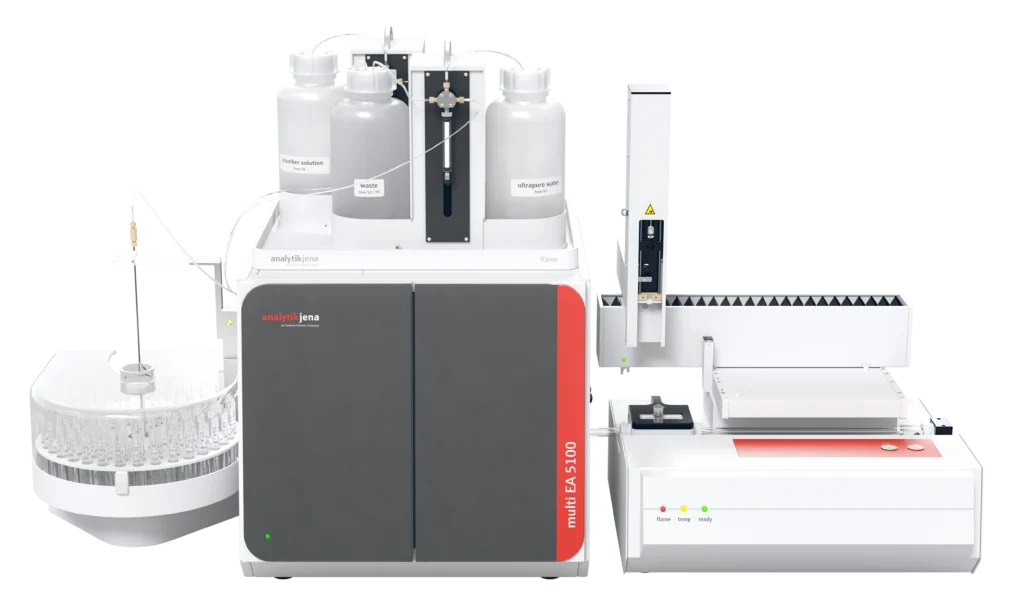
The Analytik Jena ICprep system automates pyrohydrolytic sample preparation for combustion ion chromatography workflows. The system is designed for laboratories performing AOF, EOF, TOF, AOX, and total halogen analysis across liquid and solid sample types.
The ICprep system automates:
• Sample introduction
• Controlled combustion
• Water dosing for hydropyrolysis
• Absorption of combustion gases
• Fraction collection for downstream ion chromatography (or even MS or IS) analysis
Using controlled combustion temperatures and automated water dosing, the system converts halogen and sulfur compounds into their corresponding inorganic anions for accurate downstream detection.
Integrated flame-sensor technology helps ensure complete and safe combustion while improving reproducibility and reducing manual operator involvement.
- The system supports standards-compliant workflows including DIN EN 17813 for fluorine, chlorine, bromine, and sulfur determination in environmental solids, EPA 1621 for Adsorbable Organic Fluorine (AOF) in aqueous matrices by Combustion Ion Chromatography (CIC) and DIN 38409-59 for the determination of adsorbable organically bound fluorine, chlorine, bromine and iodine by combustion and subsequent ion chromatographic measurement.
Why is pyrohydrolytic combustion important for fluorine and halogen analysis?
Pyrohydrolytic combustion is a critical stage within combustion ion chromatography because it enables complete conversion of organically bound halogens into measurable inorganic species.
During combustion at temperatures above 950 °C, fluorine compounds are converted into hydrogen fluoride, while chlorine and bromine compounds form hydrogen chloride and hydrogen bromide. These species are then absorbed into aqueous solution prior to ion chromatography analysis.
Accurate combustion control is essential for:
• Reliable fluorine recovery
• Complete oxidation
• Low detection limits
• Reproducible halogen measurements
• Standards-compliant analysis
This makes pyrohydrolysis particularly valuable for PFAS screening and total halogen determination in difficult environmental and industrial matrices.
How do Sykam ion chromatography systems measure fluoride and inorganic anions?
Following combustion and absorption, the resulting fluoride and other inorganic anions are quantified using ion chromatography.
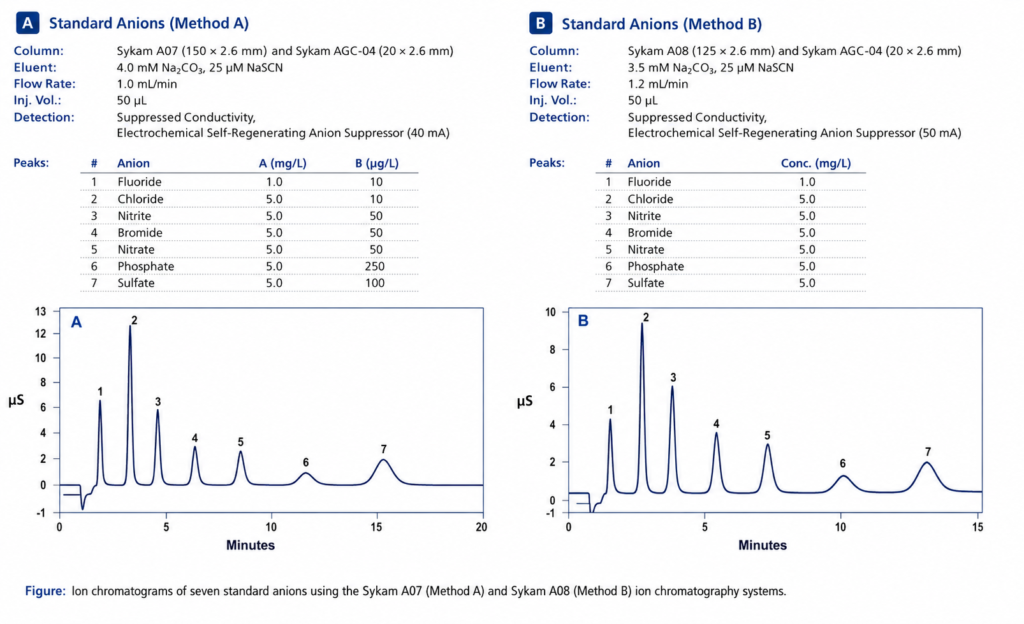
The Sykam S150+ ion chromatography system uses suppressed conductivity detection with electrochemical self-regenerating suppression technology for sensitive anion analysis. The system supports determination of:
• Fluoride
• Chloride
• Bromide
• Nitrite
• Nitrate
• Phosphate
• Sulfate
The workflow aligns with established ion chromatography methods including:
• EN ISO 10304-1
• EPA 300.1
• ASTM D4327
Sykam ion chromatography systems provide:
• Low detection limits for trace fluoride analysis
• High-resolution anion separation
• Self-regenerating suppression technology
• Modular and upgradeable system configurations
• Compatibility with combustion ion chromatography workflows
For fluoride analysis specifically, the Sykam A07 column offers high signal-to-noise performance and strong separation of early-eluting analytes, making it particularly suitable for trace-level fluorine determination.
How do ICprep and Sykam systems work together for PFAS and halogen screening?
Combining the ICprep sample preparation platform with Sykam ion chromatography systems creates a complete combustion ion chromatography workflow for PFAS and halogen analysis.
The integrated workflow enables:
• Automated AOF/AOX sample preparation
• Pyrohydrolytic combustion and halogen conversion
• Absorption of combustion products
• Ion chromatography analysis of fluoride and other anions
Together, the systems provide laboratories with a robust solution for:
• PFAS screening
• AOF analysis
• Total fluorine determination
• Halogen analysis in solids
• Environmental compliance testing
• Waste and recycling applications
Because sample preparation and ion chromatography detection are automated and highly reproducible, laboratories can achieve improved throughput while maintaining trace-level analytical performance.
What to do Next?
SciMed supplies complete combustion ion chromatography workflows for PFAS screening, AOF analysis, and halogen determination applications.
The Analytik Jena ICprep system provides automated pyrohydrolytic sample preparation for fluorine and halogen analysis, while Sykam ion chromatography systems deliver sensitive fluoride and inorganic anion detection using self-regenerating suppression technology.
To discuss combustion ion chromatography for PFAS and halogen analysis, contact the SciMed team or explore the following products:
Page FAQ's
AOF stands for adsorbable organically bound fluorine. It is a screening technique used to determine the total amount of organofluorine compounds present within a sample, including PFAS.
Combustion ion chromatography (CIC) is an analytical technique that combines high-temperature combustion with ion chromatography detection to measure fluorine, chlorine, bromine, sulfur, and other inorganic anions following sample digestion.
Combustion ion chromatography allows laboratories to determine total organically bound fluorine rather than measuring only a limited number of individual PFAS compounds. This makes it highly valuable for broad PFAS screening applications.
Relevant standards include ASTM D7359, ASTM D4327, EPA 300.1, EN ISO 10304-1, DIN EN 17813, and DIN 38409-59 depending on the application and sample type.
Contact Us Today
We take great pleasure in assisting you and ensuring you get a prompt response to your questions
Live chat opening hours Mon – Fri 9:15 to 16:30 (UK Time)