
SciMed Education
Total Inorganic Carbon Analysis in Lithium-Ion Battery Recycling
In Summary
TIC analysis provides a fast, reliable way to measure carbonate (lithium carbonate) in recycling solutions, greatly speeding up lithium recovery assessment compared to traditional methods.
Why is lithium recovery important in battery recycling?
Lithium is a critical raw material for batteries, and its demand is skyrocketing with global electrification. Governments (like the EU) have set strict recycling quotas, and high raw‐material prices make recycling economically attractive.
As a result, modern battery recycling processes aim not only to recover metals but specifically to capture lithium. The target product from recycling is often lithium carbonate (Li₂CO₃), which can be reused as a battery-grade raw material.
However, existing recycling processes struggle to recover lithium efficiently. Research (e.g. at RWTH Aachen’s IME) is focused on new methods to boost lithium recovery. By improving lithium recovery rates, recyclers can reclaim valuable Li₂CO₃ and reduce dependence on virgin raw materials.
How are lithium carbonate and lithium fluoride formed during recycling?
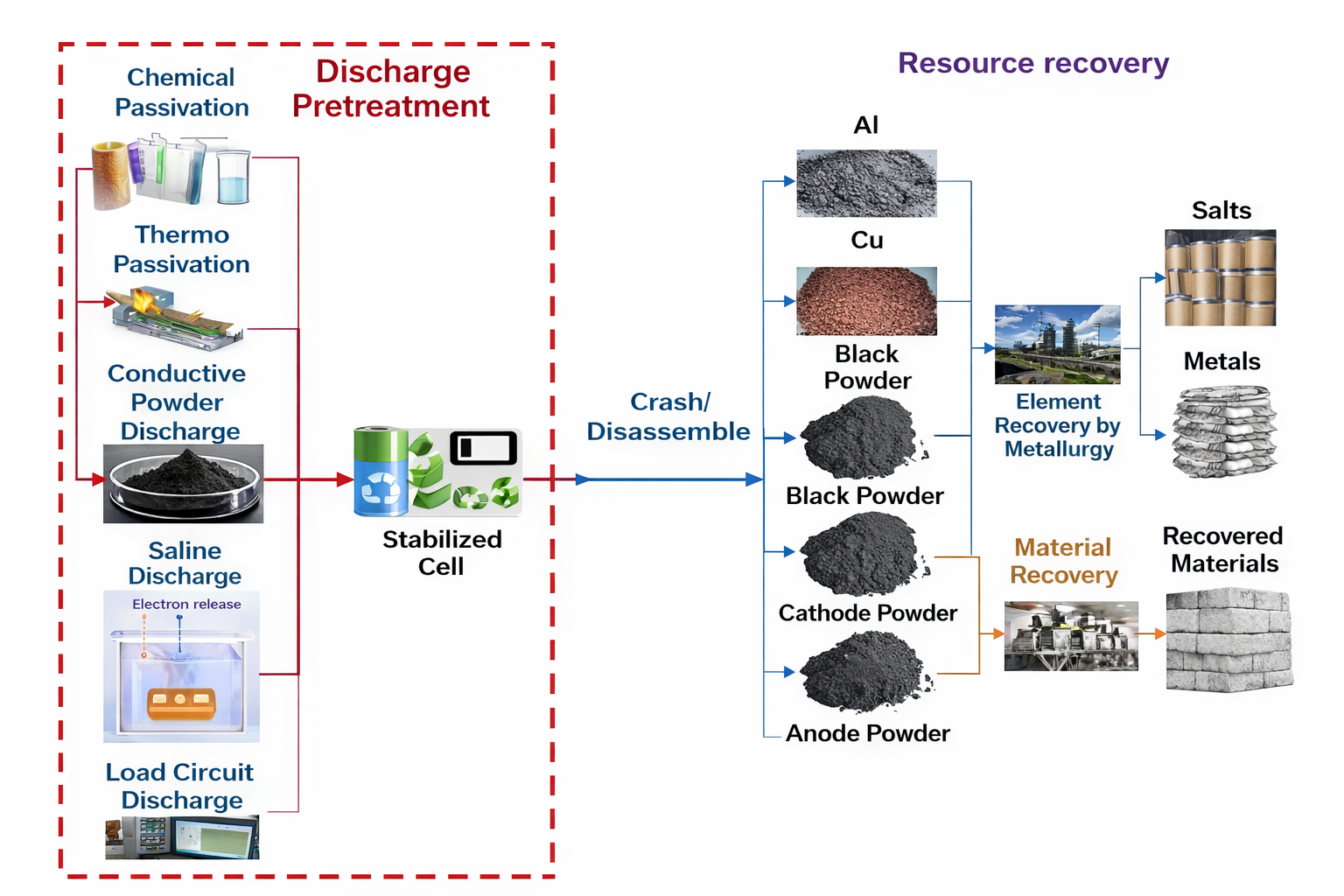
In the thermal pretreatment step of recycling, spent battery materials (cells or shredded mass) are heated under controlled conditions. This removes organics (electrolyte, binders, separators) and transforms the lithium contained in the battery into more stable compounds.
In particular, ongoing redox reactions during heating convert much of the lithium to lithium carbonate (Li₂CO₃). When this treated material is then washed with water (a “wash-out” process), the lithium carbonate dissolves into the water. Lithium fluoride (LiF) also forms during pretreatment and some LiF dissolves as well.
The dissolved salts are then recovered (for example by evaporating the water) to isolate the lithium product. For process control, it’s crucial to know how much Li₂CO₃ versus LiF is in the product, since Li₂CO₃ is the desired product and LiF is an impurity.
What is Total Inorganic Carbon (TIC) analysis and can is be used to measure dissolved carbonates (such as lithium carbonate) in a liquid sample?
Total Inorganic Carbon (TIC) analysis is an automated way to quantify dissolved carbonates (like lithium carbonate) in a liquid sample. In practice, an aliquot of the wash solution is acidified (for example with phosphoric acid) to convert carbonate (CO₃²⁻) into carbon dioxide (CO₂), which is then measured by an infrared detector.
This gives the total amount of inorganic carbon in the sample, which directly corresponds to the carbonate content. In the battery-recycling context, TIC analysis provides a quick, reliable measure of lithium carbonate in the solution. Because Li₂CO₃ is the target phase, the TIC result lets analysts infer the ratio of Li₂CO₃ to LiF in the sample.
The method is fully automated and fast: it uses small sample volumes and yields precise results with little hands-on time. (The analyzer can also measure Total Organic Carbon (TOC) in the same run, which helps check for unwanted organic contaminants from the process.)
Why use Total Inorganic Carbon (TIC) analysis instead of X-ray diffraction (XRD) or other methods for the measurement of Lithium carbonate and Li₂CO₃/LiF?
Traditionally, the Li₂CO₃/LiF fraction might be assessed by precipitating the salts and doing XRD phase analysis. However, XRD is time-consuming and only semi-quantitative.
It requires an extra precipitation step, lengthy sample preparation, and long measurement times. In contrast, TIC analysis is done directly on the solution and is highly precise. The application note showed that XRD took much longer, whereas TIC gave results quickly with very low variability.
In short, TIC analysis provides a fast, accurate, and high‐throughput alternative: it reliably indicates how much lithium carbonate has been produced without the delays of solid-phase analysis.
How are TIC results interpreted in terms of lithium recovery?
TIC results correlate with the amount of Li₂CO₃ in the sample. In the study, samples with higher Li₂CO₃ fractions (by weight) consistently produced higher TIC readings. For example, one sample with ~86% Li₂CO₃ in the precipitated salt gave a TIC of ~60.2 mg/L, while another with ~79% Li₂CO₃ gave only ~29.5 mg/L.
This demonstrates that a higher TIC value generally indicates more lithium carbonate dissolved, and thus a more successful lithium recovery in that batch. By comparing TIC across multiple samples or conditions, engineers can quickly see which thermal pretreatment or process variations yield more Li₂CO₃.
What equipment and sample volumes are required for Total Inorganic Carbon (TIC) analysis for Lithium carbonates?
The study used an automated multi N/C series TOC/TIC analyzer (Analytik Jena multi N/C 2100S/2300) with a direct injection autosampler.
These instruments are designed for small sample volumes. In fact, the multi N/C 2300 used in this work typically needs less than 5 mL of sample to perform a triplicate TIC analysis. The process is: a tiny sample aliquot (e.g. 500 µL) is mixed with phosphoric acid in the reactor, the released CO₂ is purged to an NDIR detector, and the carbon is quantified.
Because of the automated autosampler, many samples can be run sequentially with minimal human intervention. The low volume requirement and automation make TIC analysis practical for routine monitoring of battery recycle process streams.
What advantages does Total Inorganic Carbon( TIC) analysis offer in Lithium batteries (LIB) recycling?
TIC measurement is qualitative, fast, and time-saving. It rapidly highlights which process routes produce more lithium carbonate, without needing lengthy sample prep or XRD runs. The method is highly reproducible (very low standard deviation) and requires very little sample. It also provides built-in checks on organics via TOC, ensuring the leachate isn’t contaminated by residual organics that could harm product quality. In summary, TIC analysis streamlines the evaluation of thermal pretreatment and leaching steps: it saves time, uses minimal sample, and directly tracks lithium carbonate recovery, making it an effective tool for battery recycling R&D and QA.
What to do Next?
Speak to our product specialists to find the right TIC solution for your lithium ion battery recycling application.
Page FAQ's
- TIC is the amount of dissolved carbonate in a sample (measured as C). In practical terms, TIC analysis involves acidifying the sample so carbonate becomes CO₂ and is measured by infrared detection. It directly reflects the concentration of carbonates like Li₂CO₃ in the liquid.
- Because lithium carbonate is the desired recycled product, measuring TIC tells you how much Li₂CO₃ is in the wash solution. This is much faster than solid-phase analysis and lets you compare different process conditions quickly.
- XRD of the recovered salt is slow (requires precipitation and long scans) and only semi-quantitative. In contrast, TIC is done directly in solution and is highly accurate with low deviation. In other words, TIC is a quicker, more precise way to gauge Li₂CO₃ yield.
- TOC measures the dissolved organic carbon in the sample. In this process, TOC is checked to ensure that no unwanted organics (from battery electrolytes or binders) are present in the recycled product. It is an extra quality check that runs alongside TIC.
- A dedicated TOC/TIC analyzer (like Analytik Jena’s multi N/C series) with an autosampler is used. These instruments automate acidification and CO₂ detection. Importantly, they require only a few milliliters of sample per run (less than 5 mL for a set of replicates).
- No. TIC specifically measures carbonate content. Lithium fluoride content must be assessed separately (in the study this was done by ion-selective fluoride measurement and XRD phase analysis).
Contact Us Today
We take great pleasure in assisting you and ensuring you get a prompt response to your questions
Live chat opening hours Mon – Fri 9:15 to 16:30 (UK Time)