
SciMed Education
Scanning Electron Microscopy and Its Industrial Applications
In Summary
Scanning Electron Microscopy provides detailed imaging of surfaces and microstructures. It is used across research and industry to understand material behaviour and identify defects that are not visible under optical microscopes.
What is Scanning Electron Microscopy?
Scanning Electron Microscopy (SEM) is a powerful imaging tool used to observe the surface features and microstructure of materials at very high magnifications. Unlike light microscopes, which use photons, SEM uses a finely focused beam of electrons to scan across the sample surface. The effective wavelength of these electrons can be tuned to sizes significantly below visible light by increasing their voltage.
This enables users to access levels of magnification that are orders of magnitude higher than can be achieved through optical microscopy. As the electron beam interacts with the atoms in the material, various signals are emitted and collected to generate detailed images and analytical data.
SEM is essential for industries and researchers who need to analyze the structure, composition, and quality of materials down to the micro- or even nanoscales. Its capabilities extend far beyond simple imaging, providing insights into chemical composition and crystal orientation through additional detectors and techniques. A range of tools are available to heat, bend, stretch and indent materials to allow for in-situ observations of the impact of a process in real time.
How SEM Works: SE and BSE Signals
When the primary electron beam hits the surface of a sample, it causes a variety of interactions. Two of the most important signals generated are Secondary Electrons (SE) and Backscattered Electrons (BSE).
Secondary Electrons are low-energy electrons emitted from the surface atoms. They provide detailed topographical information and are ideal for imaging surface textures and fine details.
Backscattered Electrons are high-energy electrons that are reflected back from deeper inside the sample and so can lack the feel of surface topography created by secondary electrons. The intensity of BSE signals varies with the atomic number of elements in the sample, allowing for compositional contrast in imaging.
The combination of SE and BSE imaging gives a fuller picture of both surface structure and material contrast. In modern SEM operating systems these two signals are typically presented side-by-side to enable users to directly see both forms of electron signal at once.
Applications Using SE and BSE Imaging

Failure Mode Analysis
In engineering and materials science, SEM is essential for examining failed components. SE imaging reveals fracture surfaces and crack propagation paths, helping investigators determine whether a failure was brittle, ductile, or fatigue-related.
For example, a turbine blade that fails during operation can be examined under SEM. SE images might show intergranular cracking, while BSE imaging reveals compositional differences that could indicate improper alloy mixing or the presence of brittle inclusions.


Surface Analysis
SE imaging is widely used to study surface morphology in various industries. This includes observing wear patterns, corrosion pits, and machining defects on metals and polymers.
In additive manufacturing, SEM is often used to analyze sintered materials to evaluate the success of the heat treatment process. Poor sintering might show up as incomplete fusion between particles or microcracks. This allows for iterative improvements in processing conditions and part quality.
Similarly, semiconductor fabrication relies on SEM to examine surface defects and the integrity of patterned features. SE and BSE imaging can detect voids, delamination, and layer misalignments that affect device performance.
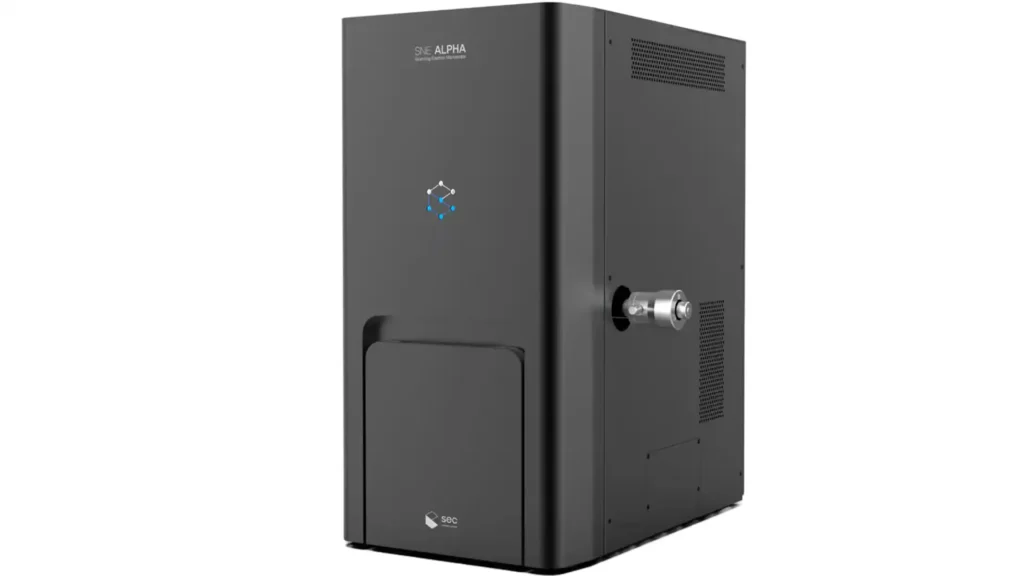
SNE Alpha 'Explore SciMed Benchtop SEM Soloution'
Surface Analysis

Particle and Contaminant Analysis
SEM plays a central role in the analysis of particulate matter. SE imaging gives clear morphology data, while BSE and EDS (discussed later) identify composition.
In air quality control, SEM helps analyze particulate pollutants collected on filters. Dust, industrial soot, and even pollen grains can be distinguished by their shape and size.
In pharmaceutical cleanrooms, SEM is used to examine contaminants that might compromise product sterility. Small debris or unknown particulates can be identified and traced back to equipment or handling procedures. BSE imaging reveals metal contaminants as much brighter objects in organic materials.
Energy Dispersive Spectroscopy
Energy Dispersive Spectroscopy (EDS) is an analytical technique used alongside SEM to determine the elemental composition of a sample. When the electron beam strikes the sample, it can knock electrons out of their orbit. When higher energy electrons fill these vacancies, they release X-rays corresponding to the difference in energy between these two orbits that are characteristic of each element.
The EDS detector measures the energy and intensity of these X-rays, providing qualitative and quantitative information about which elements are present and in what proportions. EDS detectors can produce spectra corresponding to each pixel point of an SEM image, allowing for the generation of 2D maps of elemental distribution.
EDS Applications in Industry

Mineral and Rock Analysis
In geology and mining, EDS is used to analyse the composition of rocks, minerals, and ores.
A polished thin section can be scanned to map the distribution of key elements such as iron, copper, or rare earths.
This helps identify economically valuable materials and optimize extraction techniques.

Quality Control in Pharmaceuticals
Pharmaceuticals must meet strict purity standards. EDS can verify the composition of coatings, tablets, and other formulations. It helps detect unwanted contaminants, such as metal shavings from processing equipment, or confirm the uniform distribution of active ingredients.
EDS can be used to explore the distribution of components within a pill and assess the thickness of coatings.
In powder processing, EDS also identifies foreign materials that may have entered during mixing or packaging. Even trace contaminants can compromise product efficacy or safety.

Analyzing Metal Alloys
EDS is widely used to verify alloy compositions in manufacturing and metallurgy. Whether it’s aerospace-grade titanium or stainless steel for surgical tools, the elemental makeup must be precisely controlled.
For instance, incorrect chromium levels in stainless steel can lead to corrosion and eventually part failure. EDS allows manufacturers to verify incoming raw materials or investigate unexpected performance issues.
The detection of specific metal alloys can be used in failure analysis to identify the source of a fragment.

Asbestos and Hazardous Material Testing
In environmental analysis, EDS can be used to confirm the presence of asbestos fibres and other hazardous materials in building materials.
Coupled with SEM, the technique can distinguish asbestos from similar-looking but non-hazardous fibres based on their elemental signatures. Samples can be rapidly scanned for the presence of contaminants such as heavy metals.
This capability is essential for building demolition, renovation, and safety inspections.
Electron Backscatter Diffraction
Electron Backscatter Diffraction (EBSD) is another common technique that provides crystallographic information about materials. When the electron beam strikes a tilted, polished sample, some electrons backscatter and form diffraction patterns, known as Kikuchi patterns, as they exit the crystal lattice.
These patterns are unique to the orientation of the crystal grains. An EBSD detector uses a phosphor screen to transform the electron signal into patterns of light which are captured by a sensitive camera. From this data, EBSD software can determine grain size, phase, orientation, and texture across the sample.
Image- EBSD map produced by Bruker’s pioneering eWarp detector

EBSD Applications in Industry

Photovoltaics and Crystal Orientation
In solar cell manufacturing, EBSD is used to study the grain structure of polycrystalline silicon.
The efficiency of a solar panel is heavily influenced by the grain orientation and boundaries in the active layer.
EBSD maps help optimise the growth process to produce better-aligned grains and fewer defects.

Heat Treatment of Metals
EBSD is a valuable tool in studying the effects of heat treatment on metal microstructures. After processes such as annealing, quenching, or tempering, EBSD can show how grain boundaries have changed, whether recrystallisation has occurred, or if undesirable textures have formed.
This is crucial in aerospace and automotive applications where material toughness and fatigue resistance are essential.

Additive Manufacturing and Sintering
In additive manufacturing, EBSD is used to monitor how the laser melting process affects grain growth. Improper processing can lead to columnar grains or residual stresses.
EBSD data supports process refinement for producing stronger, more reliable parts.

Weld Quality and Microstructure
In welding and joining, EBSD can examine the Heat Affected Zone (HAZ) to detect unwanted phase changes or grain growth that could weaken the joint.
This is particularly important for pipeline welding, aerospace structures, and pressure vessels.

Deformation and Strain Mapping
EBSD can also be used to map local strain distributions in materials that have undergone mechanical deformation.
This application is valuable in understanding how materials behave under load, helping improve forming processes and predict failure points in structural components.
Other Applications
Electron microscopes can be equipped with a variety of advanced tools and systems that expand their capabilities even further.

Raman Spectroscopy
Some SEMs are integrated with Raman spectroscopy systems, allowing for chemical and molecular analysis alongside imaging.
Raman is particularly useful for identifying polymers, biological materials, and carbon-based compounds.
When combined with SEM, it provides both structural and molecular-level insights from a single platform.

In-Situ Testing Stages
Modern SEMs often support in-situ testing stages, enabling real-time observations of material behaviour under different conditions. Heating and cooling stages allow users to observe phase changes, grain growth, or oxidation as they occur.
Mechanical testing stages can apply stress, compression, or tension to watch how materials deform or fracture.
This dynamic approach is key to understanding failure mechanisms and material limits, providing critical insights into a process and its effects.

FIB Milling and Cross-Sectioning
SEM instruments are frequently paired with a Focused Ion Beam (fFIB), which allows for precise material removal at the micron or nanometer scale.
FIB milling can create cross-sections of coatings, multilayer structures, and devices, revelaing hidden feautures beneath the surface. This is essential in microelectronics, failure analysis, and sample preparation for Transmission Electron Microscopy (TEM) where atomic resoloutionscan be achieved.
What to do next?
If you require more information, such as detailed application notes or a conversation with a member of our team, please contact us using the methods provided below. Alternatively, you can explore SciMed’s SEM Range.
Page FAQ's
Surface structures, fractures, inclusions and microlevel features.
Materials science, electronics, batteries, manufacturing and geology.
Yes. Tungsten and field emission SEMs from CIQTEK.
Contact Us Today
We take great pleasure in assisting you and ensuring you get a prompt response to your questions
Live chat opening hours Mon – Fri 9:15 to 16:30 (UK Time)