
SciMed Education
AD Systems Firmware Updates for Automated Fuel Testing and Petroleum Testing Automation
Introduction
AD Systems firmware updates and hardware improvements support automated fuel testing by improving usability, method alignment, instrument reliability and workflow consistency across key petroleum testing systems including the VD10 Automated Distillation Analyser, TO10 Thermal Oxidation Stability Test Rig, CT10 Automated Corrosion Rater and SP20 Automated Smoke Point Tester.
What are the latest AD Systems firmware updates for automated fuel testing?
AD Systems has introduced a series of firmware and hardware updates across several automated petroleum testing instruments, with improvements covering automated distillation, jet fuel thermal oxidation testing, automated corrosion rating and automated smoke point testing. These updates are designed to support laboratory users by improving software behaviour, refining instrument operation, updating method handling and making day-to-day testing processes easier to manage.
The updates include new firmware for the VD10 Automated Distillation Analyser, a redesigned thermocouple for the TO10 Thermal Oxidation Stability Test Rig, new firmware for the CT10 Automated Corrosion Rater, new firmware for the SP20 Automated Smoke Point Tester and updated recognition of AD Systems heater tube kits within ASTM D3241 and IP323.
How does the VD10 Automated Distillation Analyser firmware update support automated fuel testing?
The VD10 Automated Distillation Analyser firmware update, version 1.0.3.2, introduces a number of smaller improvements intended to make the software more user-friendly and robust, while also correcting minor issues that could affect operation. For laboratories carrying out automated distillation of fuels and solvents, these types of updates are important because they help maintain consistent instrument behaviour and reduce unnecessary interruptions during routine testing.
One of the key updates is the ability to set barometric pressure units to mmHg for LIMS export, instead of using the default hPa setting. This is useful for laboratories where reporting formats, data transfer workflows or internal systems require pressure values to be handled in a specific unit format.
Why is the VD10 Automated Distillation Analyser firmware update important for LIMS export?
The VD10 Automated Distillation Analyser firmware update supports LIMS export by allowing barometric pressure units to be set to mmHg when required. This is important because automated fuel testing laboratories often rely on structured data transfer between instruments and laboratory information management systems, and unit compatibility can help reduce manual handling of data.
By making this adjustment available within the VD10 software, laboratories can align the exported data format more closely with their reporting requirements. This helps support a smoother digital workflow for automated distillation results and reduces the need for additional data conversion after testing.
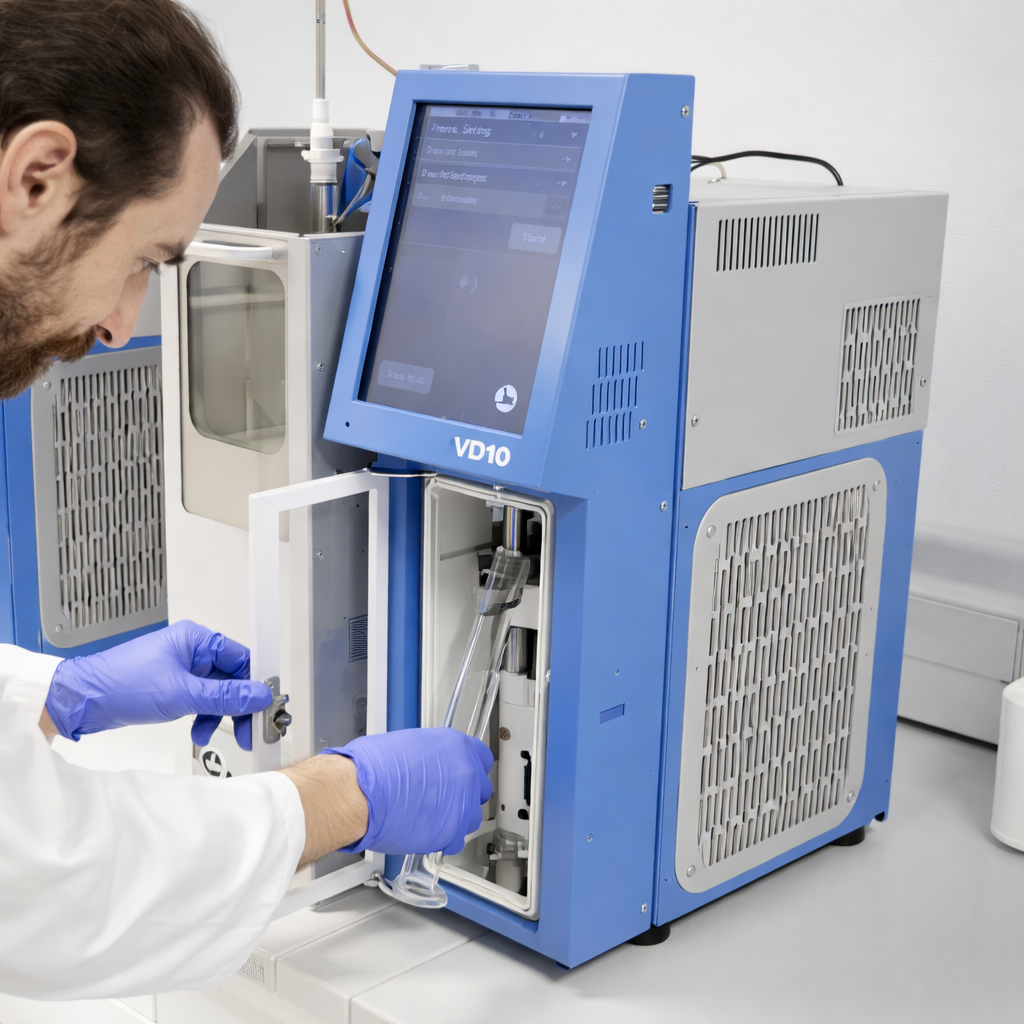
How does the VD10 Automated Distillation Analyser firmware update improve test operation?
The VD10 firmware update eliminates a false “Empty flask” error message that could sometimes occur at start-up. This improvement helps reduce unnecessary operator intervention and supports a more straightforward start to the automated distillation workflow.
The update also corrects the handling of the decimal separator when a comma is used, which had been problematic in the previous software version. For laboratories that work with regional number formats or data systems where commas are used as decimal separators, this correction helps ensure values are handled correctly within the instrument software.
How does the VD10 Automated Distillation Analyser firmware update support heavy Group 4 samples?
The VD10 firmware update maintains the condenser warm at the end of a test when heavy Group 4 samples are being analysed. This has been introduced to help facilitate condenser cleaning where paraffinic residues may be present.
For automated distillation testing, sample behaviour can vary depending on the fuel or solvent type being analysed, and heavier samples can leave residues that require careful cleaning. By keeping the condenser warm at the end of the test, the VD10 update supports easier post-test handling where these heavier sample types are involved.
How does the VD10 Automated Distillation Analyser firmware update improve sample charge handling?
The VD10 firmware update adds the ability to scan the exact volume of the sample charge in the receiving cylinder before it is transferred into the flask. This function can be enabled or disabled through the Settings and Lists menu, giving laboratories control over whether this additional step is included in their routine workflow.
This feature supports more detailed handling of the sample charge before the automated distillation process begins. For laboratories that want to confirm the exact sample volume before transfer, this provides an additional operational option within the VD10 system.
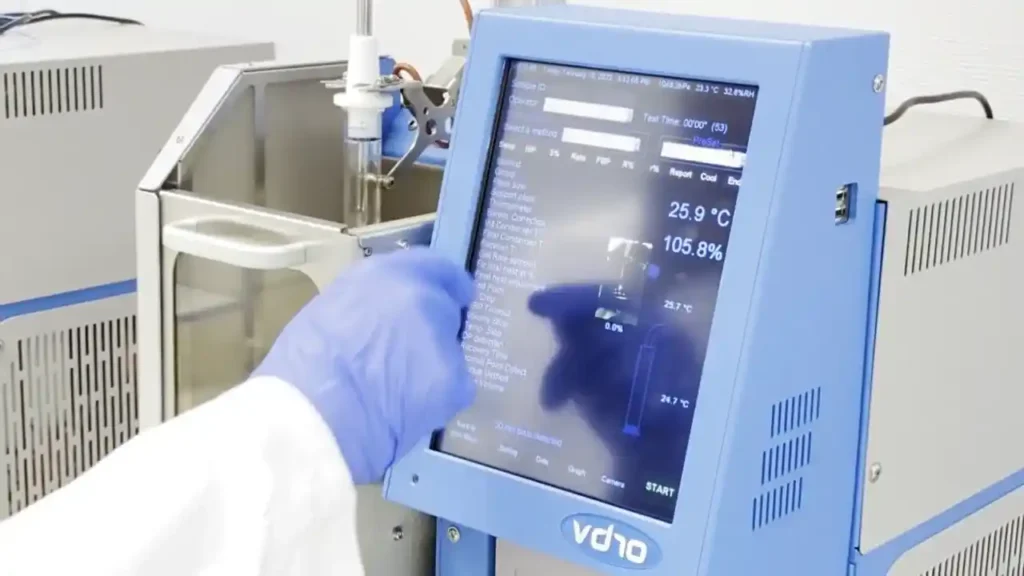
How has the TO10 Thermal Oxidation Stability Test Rig thermocouple been improved for jet fuel testing?
The TO10 Thermal Oxidation Stability Test Rig heating tube thermocouple has been redesigned to improve practical handling during use. The updated thermocouple now features a spherical tip, a single-piece machined head and a new, more flexible cable.
These design changes help make insertion and removal of the thermocouple easier, while also supporting consistent positioning. In jet fuel thermal oxidation testing, the position and handling of key components are important because users need reliable setup, repeatable operation and long service life from parts used in routine testing.
Why is consistent thermocouple positioning important in TO10 jet fuel thermal oxidation testing?
Consistent thermocouple positioning is important in TO10 jet fuel thermal oxidation testing because the thermocouple is part of the heating tube assembly and must be placed reliably during operation. The redesigned TO10 thermocouple supports this by making insertion and removal easier, while helping maintain perfect and consistent positioning.
The updated design also supports long service life through its single-piece machined head and more flexible cable. This provides a more practical component for laboratories carrying out regular jet fuel thermal oxidation testing using the TO10 system.
How is the TO10 Thermal Oxidation Stability Test Rig thermocouple supplied?
The TO10 thermocouple is supplied factory-calibrated at three points: ice, tin and lead. It is also supplied with a calibration certificate and is ready for immediate use by the customer.
This means the component arrives prepared for laboratory use, with calibration already completed before it is supplied. For laboratories working with automated jet fuel thermal oxidation testing, this helps simplify replacement or implementation of the updated thermocouple. The ordering part number for the redesigned TO10 thermocouple is AD211-015.
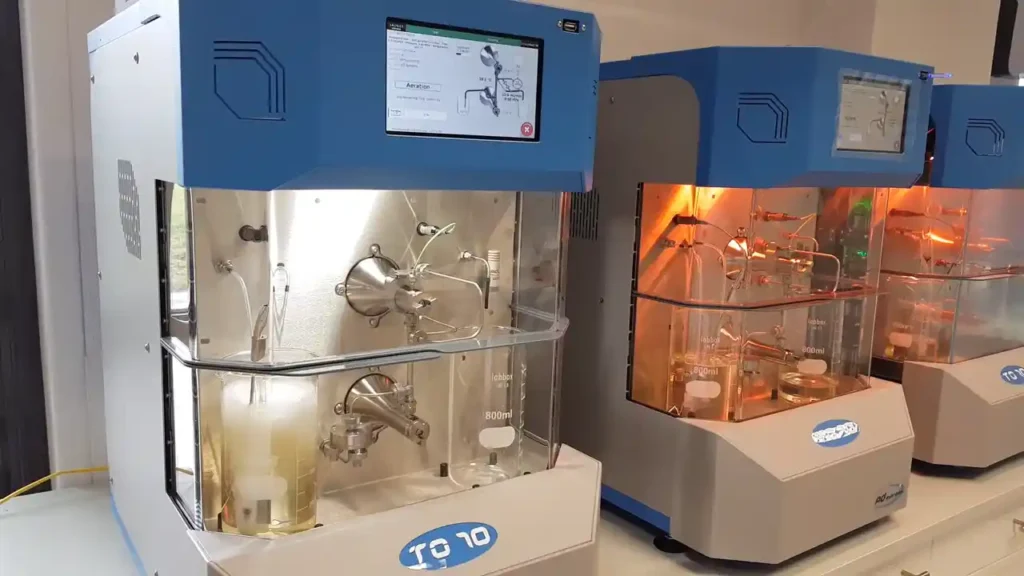
How does the CT10 Automated Corrosion Rater firmware update support corrosion rating?
The CT10 Automated Corrosion Rater firmware update, version 2.0.0.6, introduces a new user interface along with several improvements and fixes. One of the most important changes is an update to the rust detection algorithm so that it fits the ASTM D665-25 definition.
This same definition is employed for ISO 7120, IP 135, JIS and GB/T11143 methods, which means the CT10 can apply the appropriate algorithm according to the test method selected by the user. This is important because automated corrosion rating must follow the correct method logic in order to support reliable and method-appropriate results.
Why does the CT10 Automated Corrosion Rater use different corrosion rating algorithms?
The CT10 Automated Corrosion Rater uses the appropriate rating algorithm according to the test method selected. The rust detection algorithm has been updated for ASTM D665-25, with the same definition employed for ISO 7120, IP 135, JIS and GB/T11143 methods.
The NACE TM0172 and ASTM D7548 corrosion rating algorithm remains unchanged. This distinction matters because different corrosion rating methods can require different interpretation logic, and the CT10 firmware update ensures that the instrument applies the correct algorithm based on the selected method.
How does the CT10 Automated Corrosion Rater firmware update support existing instruments?
The CT10 firmware update is compatible with CT10 analysers already in service that are running under Windows XP, as well as with the new Windows 11 IoT operating system currently being supplied. This makes the update relevant for both existing installed instruments and newer CT10 systems.
The user manual has also been updated to reflect the firmware changes. When updating CT10 units already in service, users should be provided with the new manual and should be made aware of the differences in the rating algorithms, particularly where the selected test method affects the algorithm being applied.
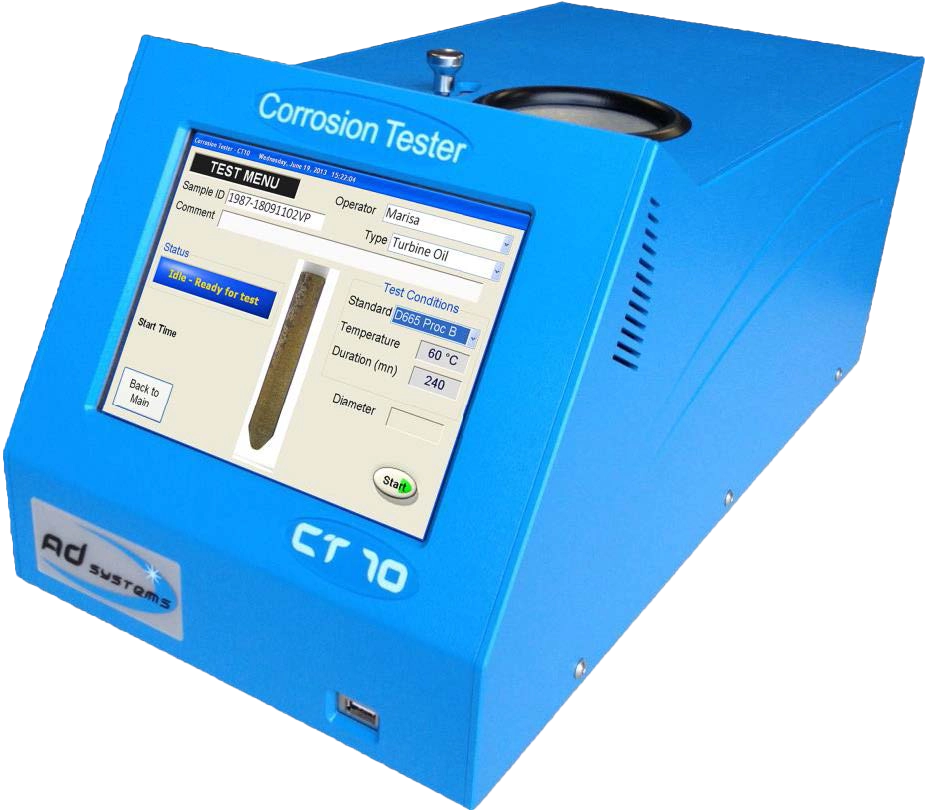
How does the SP20 Automated Smoke Point Tester firmware update support automated smoke point testing?
The SP20 Automated Smoke Point Tester firmware update, version 2.0.2.0, has been released primarily to add Japanese to the existing language options. The SP20 already includes English, French, Spanish, Portuguese, Chinese and German, and the new firmware extends the available language options further.
This update also includes a few minor changes, including a redesign of the alphanumeric keypad so that it contains more letters and symbols. These changes support the practical usability of the SP20 interface during automated smoke point testing.
Should the SP20 Automated Smoke Point Tester Japanese language pack always be installed?
The SP20 firmware update is compatible with all SP20 units currently in use, but installing the Japanese language pack is not recommended unless there is a specific need for it. This means laboratories should consider whether the additional language option is required before applying that part of the update.
For users who do require Japanese language support, the update provides an expanded interface option. For users who do not need this language option, the guidance is to avoid installing the Japanese language pack unnecessarily.
How does the SP20 Automated Smoke Point Tester firmware update improve day-to-day smoke point testing?
The SP20 Automated Smoke Point Tester firmware update helps improve day-to-day smoke point testing by making the instrument interface more practical for laboratory users. The redesigned alphanumeric keypad provides access to more letters and symbols, which can support clearer data entry during routine operation. This is especially useful in laboratories where users need to enter sample details, method information or identifiers directly into the instrument software as part of the automated smoke point testing workflow.
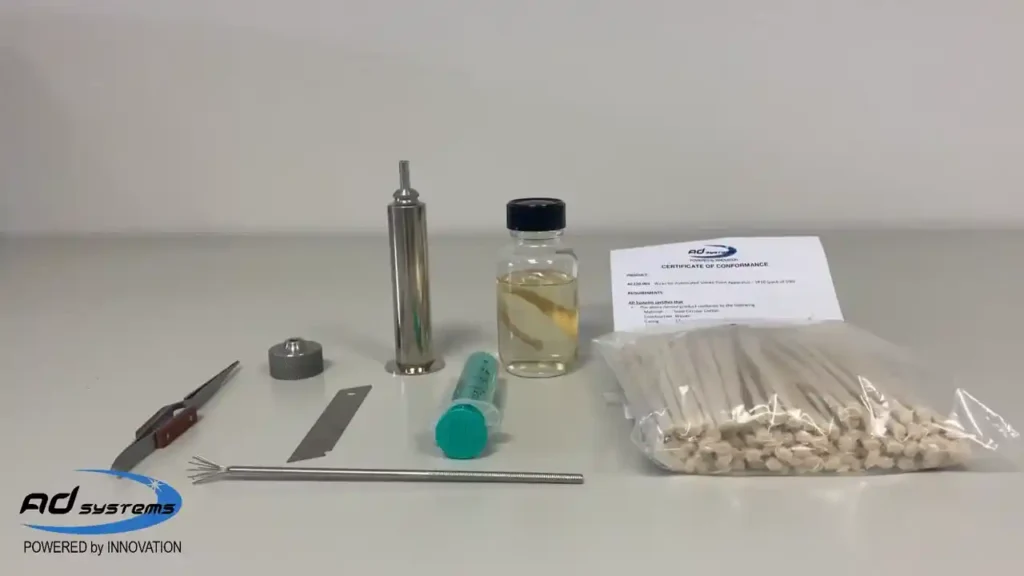
How do AD Systems heater tube kits support ASTM D3241 and IP323 jet fuel testing?
AD Systems heater tube kits are now included as part of ASTM D3241-26 and IP323/26, with AD Systems recognised as an official alternative supplier of heater tube kits. These heater tube kits can be used for jet fuel certification with all brands of existing JFTOT equipment.
A large-scale inter laboratory study demonstrated statistical equivalency to traditional suppliers for both rating methods: visual VTR and metrology deposit thickness measurement. This supports the use of the AD Systems heater tube kits within the relevant jet fuel thermal oxidation stability testing workflow.
Why is ASTM D3241 heater tube kit recognition important for jet fuel certification?
ASTM D3241 heater tube kit recognition is important because heater tubes are a key part of the jet fuel thermal oxidation stability testing process. With AD Systems included as an official alternative supplier of heater tube kits, laboratories carrying out jet fuel certification have an additional recognised option for existing JFTOT equipment.
Because the heater tube kits can be used with all brands of existing JFTOT equipment, they are not limited to one instrument brand. This makes the update relevant to laboratories using a range of jet fuel thermal oxidation stability testing systems.
What do these AD Systems updates mean for petroleum testing laboratories?
These AD Systems updates show how automated petroleum testing instruments continue to evolve through firmware improvements, interface updates, component redesigns and method alignment. For laboratories working with automated distillation, jet fuel thermal oxidation stability, corrosion rating and smoke point testing, these updates help support practical operation and method-specific testing requirements.
Rather than changing the purpose of each instrument, the updates focus on improving how the systems are used day to day. This includes clearer data export options, improved component handling, updated algorithms, expanded language settings and recognised heater tube kit availability for jet fuel certification.

What to do next?
If your laboratory uses AD Systems instruments for automated distillation, jet fuel thermal oxidation stability testing, automated corrosion rating or automated smoke point testing, it is worth checking whether your current system is running the latest relevant firmware and whether any updated components or manuals are required.
For support with AD Systems petroleum testing instrumentation, firmware updates, spare parts, heater tube kits or product selection, contact SciMed to speak with a product specialist. SciMed can help identify the correct instrument, component or update route for your fuel testing application.
Page FAQ's
The latest AD Systems updates include firmware improvements for the VD10 Automated Distillation Analyser, CT10 Automated Corrosion Rater and SP20 Automated Smoke Point Tester, alongside hardware and component updates for the TO10 Thermal Oxidation Stability Test Rig and AD Systems heater tube kits.
The VD10 firmware update improves automated distillation testing by adding mmHg pressure units for LIMS export, correcting decimal separator handling, removing a false “Empty flask” start-up message and supporting improved handling of heavy Group 4 samples.
The TO10 thermocouple has been redesigned with a spherical tip, single-piece machined head and more flexible cable, making insertion and removal easier while helping maintain consistent positioning during jet fuel thermal oxidation stability testing.
AD Systems heater tube kits are now included as part of ASTM D3241-26 and IP323/26, with AD Systems recognised as an official alternative supplier for heater tube kits that can be used for jet fuel certification with all brands of existing JFTOT equipment.
Contact Us Today
We take great pleasure in assisting you and ensuring you get a prompt response to your questions
Live chat opening hours Mon – Fri 9:15 to 16:30 (UK Time)