
SciMed Education
How can trace metals in cannabis and hemp be analyzed using High Resolution ICP-OES?
In Summary
High Resolution ICP-OES enables accurate, interference-free detection of trace metals in cannabis and hemp, delivering sub-μg/L sensitivity and reliable compliance with global safety standards using a robust and cost-effective workflow.
What is the challenge?
Analysis of heavy metals in cannabis with high sensitivity, precision, and accuracy.
What is the solution?
HR ICP-OES with exceptional sensitivity and high-resolution optics for interference-free detection.
What are cannabis and hemp, and why analyze them?
Cannabis and hemp are ancient crops used primarily for textiles, food, and medicinal or recreational products.
With legalization, ensuring the safety of cannabis products has become critical. Toxic elements such as As, Pb, Hg, and Cd—known as the “toxic four”—are routinely analyzed to meet regional safety standards like those from the California Bureau of Cannabis Control, FDA, and US EPA.

How are samples prepared and analyzed?
Sample Preparation
• 1 g dried plant material is weighed
• Digested in microwave vessel with HNO₃, HCl, and H₂O₂
• Cooled and diluted to 50 mL with deionized water
• Au is added to stabilize Hg, and Tb is used as an internal standard
Instrumentation
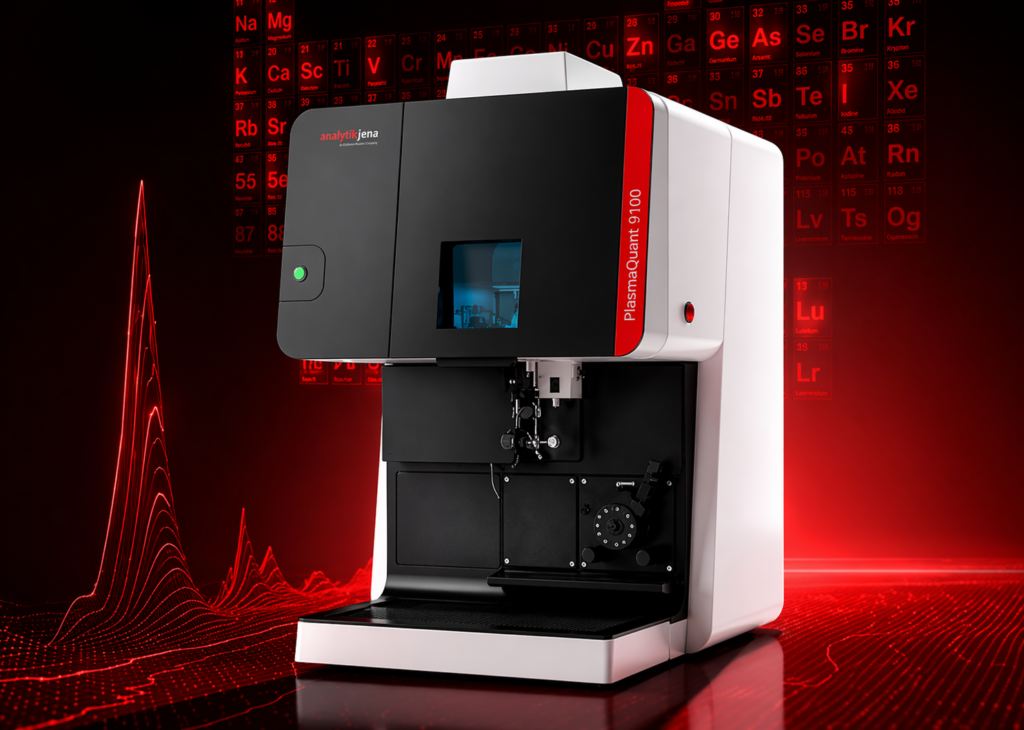
Analysis is performed using the PlasmaQuant 9100 Elite ICP-OES with a standard sample introduction kit, seaspray nebulizer, and Teledyne Cetac ASX 560 autosampler.
Method Overview
High-resolution ICP-OES allows sub-μg/L detection of As, Cd, Cr, Hg, and Pb in plant matrices. The method eliminates the need for complex accessories like ultrasonic nebulizers while maintaining high precision and robustness.
What parameters are used for evaluation?
Method-specific parameters used for evaluation include plasma view and integration mode, read time and baseline correction (ABC), internal standard correction using Tb, and multi-line evaluation to ensure accuracy.
What results were achieved?
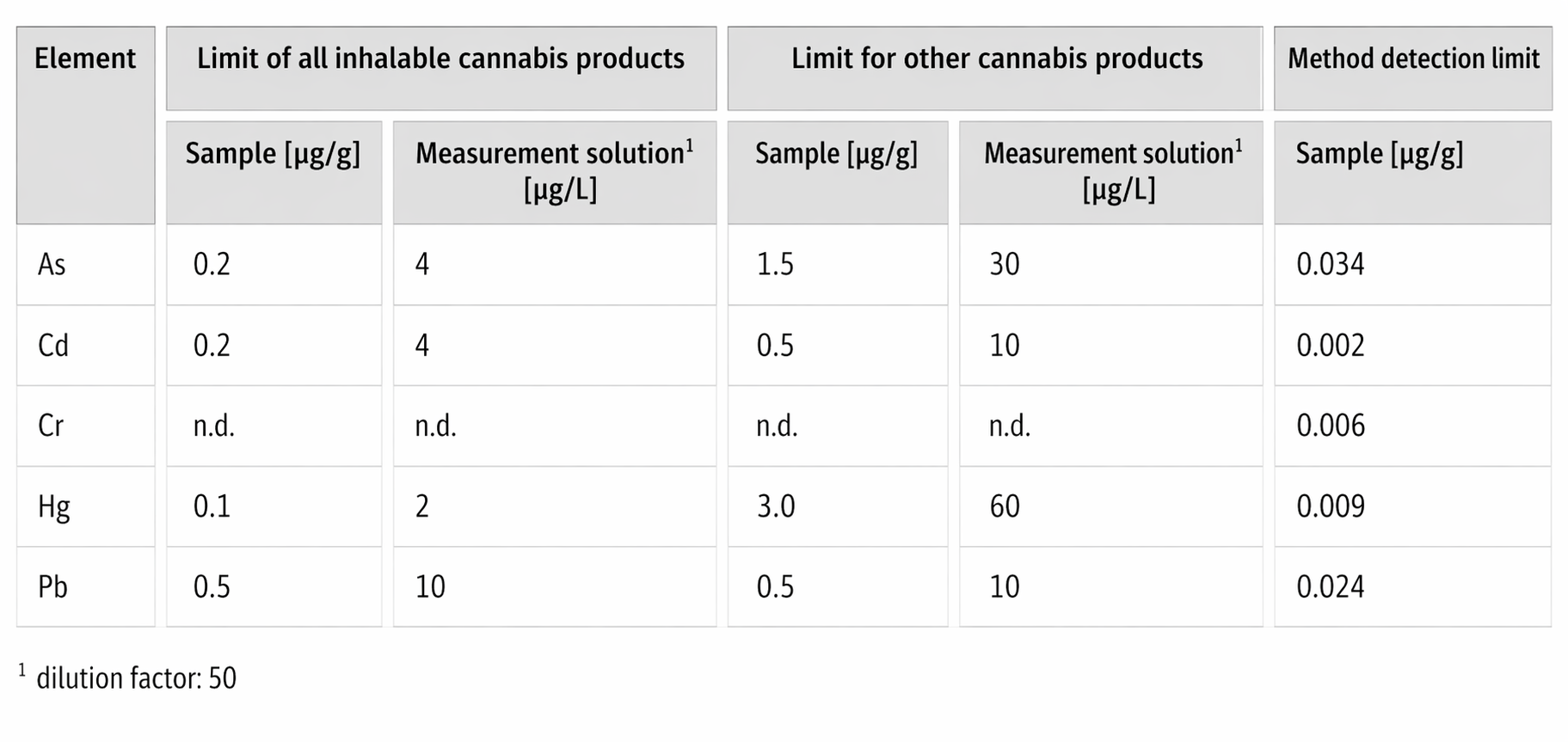
Method detection limits (MDLs) are well below regulatory limits for cannabis products:
- As: 0.034 μg/g
- Cd: 0.002 μg/g
- Cr: 0.006 μg/g
- Hg: 0.009 μg/g
- Pb: 0.024 μg/g
Spike recovery tests confirmed accuracy within ±7%, and multi-line evaluation demonstrated interference-free quantification thanks to the high-resolution optics.
CLICK TO VIEW IMAGE

Why is this method effective?
The PlasmaQuant 9100 Elite provides:
• Interference-free analysis via high spectral resolution (2 pm @ 200 nm)
• Accurate detection of toxic metals at sub-μg/L levels
• Reliable results using standard sample introduction without costly accessories
• A robust, user-friendly, and cost-efficient alternative to ICP-MS
This makes it ideal for routine cannabis and hemp quality control laboratories. The PlasmaQuant 9200 Elite combines the same high performance with a smaller footprint low argon and energy consumption.
What to do Next?
Ready to improve your cannabis and hemp analysis? Enhance your trace metal testing workflow by requesting product details, speaking with an expert, scheduling a demo, or contacting SciMed to learn more.
Page FAQ's
Trace metals in cannabis and hemp can be accurately analysed using High Resolution ICP-OES, which provides the sensitivity, precision, and spectral resolution required to detect elements such as arsenic, cadmium, mercury, and lead at very low concentrations without interference from complex plant matrices.
Trace metal analysis is essential to ensure cannabis and hemp products meet strict regulatory requirements and are safe for consumption. Toxic elements such as As, Pb, Hg, and Cd, often referred to as the “toxic four”, must be carefully monitored to comply with standards set by regulatory bodies including the California Bureau of Cannabis Control, FDA, and US EPA.
Cannabis samples present analytical challenges due to their complex organic matrix, which can cause spectral interferences and affect measurement accuracy. Achieving high sensitivity and reliable quantification at trace levels requires advanced instrumentation capable of overcoming these interferences.
High Resolution ICP-OES uses high-resolution optics to separate overlapping spectral lines, enabling interference-free detection of trace elements. Combined with internal standard correction using terbium and multi-line evaluation, this ensures accurate and reliable quantification even in complex sample matrices.
Contact Us Today
We take great pleasure in assisting you and ensuring you get a prompt response to your questions
Live chat opening hours Mon – Fri 9:15 to 16:30 (UK Time)