
SciMed Education
How to perform accurate trace element analysis in battery‑grade lithium carbonate using HR ICP‑OES
Introduction
High‑resolution inductively coupled plasma optical emission spectroscopy (HR ICP‑OES) enables sensitive and robust analysis of trace impurities in battery‑grade lithium carbonate. The PlasmaQuant 9100 Elite instrument combines high spectral resolution, high plasma robustness and intelligent torch design to provide detection limits in the low to sub‑parts‑per‑billion range while tolerating the high lithium concentrations typical of these samples. Such performance supports the growing requirement for high‑purity lithium carbonate in lithium‑ion batteries.
Why is trace element analysis in lithium carbonate important for lithium‑ion batteries?
Lithium carbonate is the principal raw material for lithium‑ion battery cathodes. Impurities such as sodium, calcium, magnesium and sulfur can adversely affect battery performance; sodium can cause overheating, and other contaminants interfere with the electrolysis steps used to produce lithium metal. The rapid growth of e‑mobility and renewable energy storage means that manufacturers now demand lithium carbonate with purities of 99.5 % or higher, and the trend is moving toward ≥ 99.9 %. To ensure these purity levels, laboratories need analytical methods capable of detecting trace elements at low concentrations in a matrix dominated by easily ionizable lithium ions.

How is lithium carbonate produced and why does purification matter?
Lithium carbonate originates from brines pumped from the so‑called “lithium triangle” in South America, where saline groundwater is evaporated leaving a viscous concentrate that is further processed to lithium carbonate. In thin‑film polymer batteries lithium carbonate is converted to lithium chloride and then electrolyzed to lithium metal; excessive calcium, magnesium or sulfur in the carbonate compromise this step. Monitoring impurities in the raw material is therefore essential to protect downstream processes and guarantee the quality of the final battery product.
What sample preparation and calibration steps were used?
Sample preparation focused on maintaining a high lithium matrix to avoid ionization interferences. Laboratory glassware was rinsed with deionized water, and working standards were prepared by serial dilution of a multi‑element standard in polypropylene vessels. The blank solution and all calibration standards were matrix‑matched to 5 % (w/v) lithium carbonate and acidified with nitric acid (pH < 1).
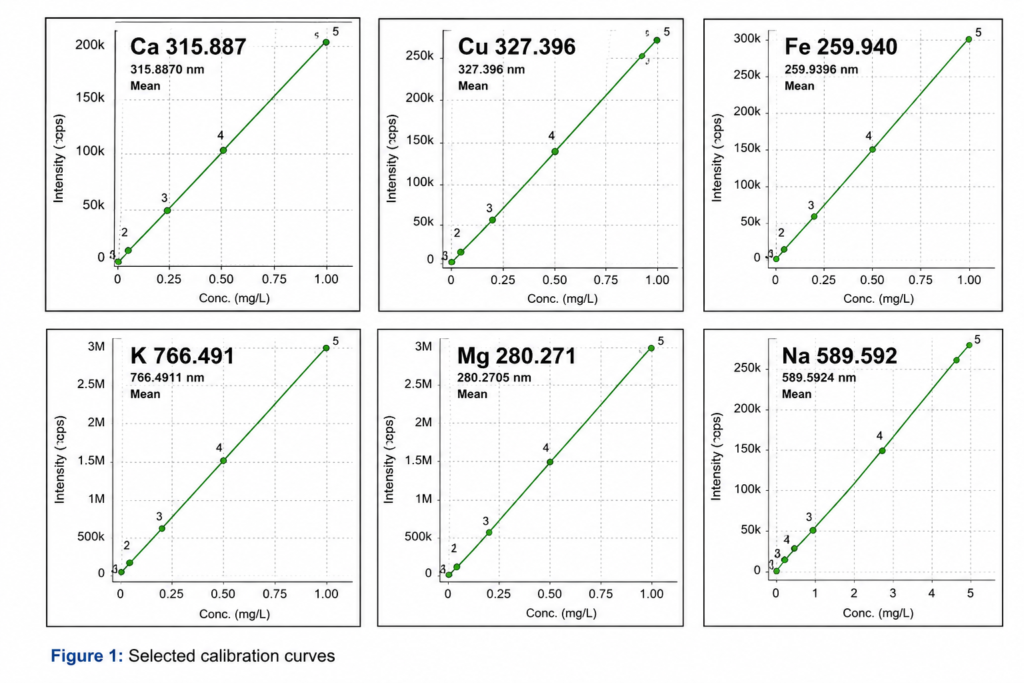
Calibration levels were chosen based on expected impurity concentrations; at least six calibration points were used for each element. Selected analytes—including aluminium, calcium, copper, iron, potassium, magnesium, manganese, nickel, lead, silicon, sodium, sulfur and zinc—were calibrated across ranges from 0.01 mg/L up to 1 mg/L or higher depending on the element.
What instrument settings and method parameters were selected?
The analyses were performed on a PlasmaQuant 9100 Elite HR ICP‑OES configured for high salt matrices. The instrument used a glass concentric SeaSpray™ nebulizer, a cyclonic spray chamber with a dip tube, and a 2 mm inner‑diameter quartz injector tube. Plasma power was set to 1 350 W with a 14 L/min plasma gas flow, 1 L/min auxiliary gas flow and 0.6 L/min nebulizer gas flow. Pump rates of 1.0 mL/min for analysis and 2.0 mL/min for rinsing were used, and the torch position was offset by −1 mm to reduce salt deposits.
Method parameters such as wavelength, integration time and baseline correction were optimized for each element; for example, the Al 396.152 nm line was measured in axial view with a one‑second integration and automated baseline correction.
How does the PlasmaQuant 9100 Elite deliver high sensitivity and spectral resolution?
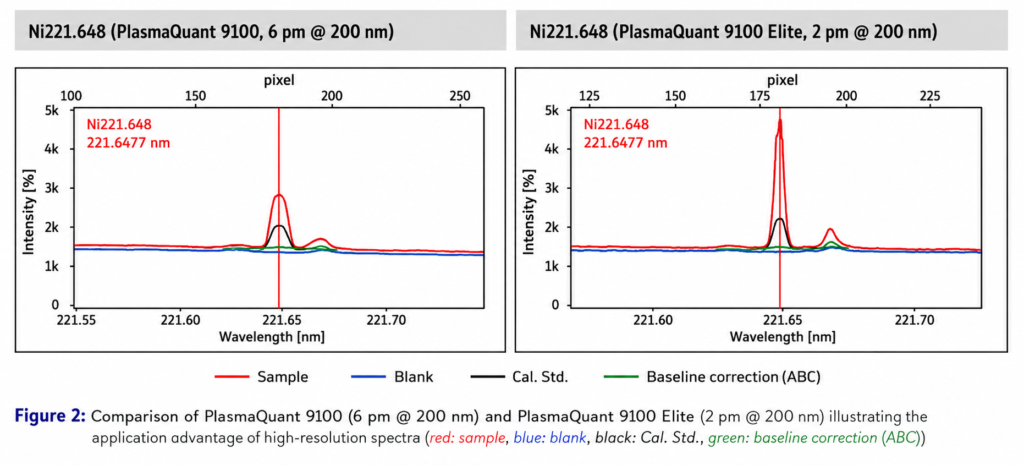
The PlasmaQuant 9100 Elite incorporates a four‑wind induction coil and counter‑gas technology that extend the axial observation zone, maximizing signal collection. Its spectral resolution of 2 pm at 200 nm allows the instrument to resolve closely spaced emission lines, eliminating the need for complex inter‑element corrections and enabling interference‑free quantification. The high sensitivity means samples can be further diluted to reduce salt deposition without compromising detection limits. Instrumental detection limits achieved for most elements were in the sub‑µg/L range; for example, the method detection limit for iron was 0.006 mg/kg and for magnesium 0.002 mg/kg.
These limits comfortably meet or exceed purity specifications for battery‑grade lithium carbonate, which require elements such as aluminium, iron and lead to be below a few milligrams per kilogram.

How accurate are the analyte recovery and what were the detection limits?
Accuracy was assessed using a spike recovery experiment with a 0.1 mg/L spiked blank solution. Recoveries for all analytes were within ± 3 %, demonstrating reliable quantification even at trace levels. Table 5 in the application note shows that the found concentrations closely matched the spiked amounts, with relative standard deviations (RSD) typically below 1 %. Instrumental detection limits (IDLs) ranged from 0.1 µg/L for magnesium and manganese to 7.9 µg/L for sulfur, while method detection limits (MDLs) after dilution were below 0.2 mg/kg for all elements.
These detection capabilities allow analysts to confirm that impurities are within the stringent specifications of 99.90–99.95 % purity lithium carbonate.
How robust is the method over long analysis periods?
Instrument robustness is crucial when analyzing high‑salt matrices such as lithium carbonate solutions. The high‑frequency generator of the PlasmaQuant 9100 Elite produces a stable plasma that maintains signal intensity over extended runs. To evaluate stability, a quality control sample was aspirated continuously for 4.5 hours; analyte recoveries remained between 93 % and 105 %, and RSD values were below 2.2 %.
The instrument’s intelligent torch design reduces the formation of salt deposits on the injector and other glassware, simplifying maintenance and minimizing downtime. These features collectively ensure that laboratories can reliably monitor trace impurities in lithium carbonate without frequent interventions.
Can this methodology be applied to other battery materials?
Although the study focused on lithium carbonate, the authors note that the high‑resolution ICP‑OES methodology can be readily extended to other battery materials such as lithium hydroxide. The combination of high sensitivity, spectral resolution and plasma robustness enables precise trace element analysis across a range of high‑salt or difficult matrices. This versatility supports the evolving needs of battery manufacturers who work with multiple lithium compounds.
What to do next?
If you manufacture or analyze lithium‑ion battery materials and require advice on trace element analysis, our specialists can help. SciMed supplies the PlasmaQuant 9100 Elite and can guide you on sample preparation, calibration strategies and instrument configuration for high‑purity lithium carbonate or other materials. Visit our product pages or contact us to discuss your application and explore how HR ICP‑OES can support your quality control and research objectives.
Page FAQ's
Even small amounts of sodium, calcium, magnesium or sulfur can degrade lithium‑ion battery performance and shorten lifespan.
Method detection limits are generally below 0.2 mg/kg; for example, iron was detected down to 0.006 mg/kg and magnesium to 0.002 mg/kg.
All calibration standards and samples are matrix‑matched to 5 % (w/v) lithium carbonate and acidified with nitric acid to minimize ionization interferences.
Yes. Continuous aspiration of a quality control sample for 4.5 hours yielded recoveries within 93–105 % and RSD values below 2.2 %, indicating strong long‑term stability.
Contact Us Today
We take great pleasure in assisting you and ensuring you get a prompt response to your questions
Live chat opening hours Mon – Fri 9:15 to 16:30 (UK Time)