
SciMed Education
Elemental analysis of lithium ores using PlasmaQuant 9100 Elite high‑resolution ICP‑OES
Introduction
Lithium’s growing economic importance for green energy storage has led to increased demand for accurate and efficient analysis of lithium‑bearing ores. The PlasmaQuant 9100 Elite high‑resolution ICP‑OES and the speedwave XPERT microwave digestion system provide a robust approach for determining both major elements (such as aluminium, iron, lithium and sodium) and trace/pathfinder elements (such as beryllium, caesium, rubidium and tantalum) in digests of lithium ore samples. DualView PLUS plasma observation extends the linear dynamic range from sub‑µg L⁻¹ levels to percent‑level concentrations, enabling all target elements to be quantified in a single measurement run.
Why is analysing lithium ore composition important for energy storage and exploration?
Lithium plays a critical role in green energy storage devices, and global demand has increased accordingly. The metal is mainly extracted from brine deposits in salars and geothermal fields, but other important sources include clays, granites and granite‑related pegmatites. Before these minerals are processed, it is essential to characterise major and minor components because the presence of other elements determines ore grade and suitable processing procedures.
Traditional exploration methods based on geological features are less effective for lithium because the element is widely distributed in the Earth’s crust and is not associated with specific formations; instead, analysis of “pathfinder” elements such as beryllium, rubidium, caesium and tantalum helps identify prospective deposits.

What challenges arise in exploring and analysing lithium ores and how do pathfinder elements help?
Because lithium deposits are not linked to distinctive geological markers, exploration can be expensive and time‑consuming. Pathfinder elements are chemically similar to lithium and often occur alongside it, so analysing these elements in soil and rock samples provides an efficient way to locate lithium resources. Unlike drilling and sampling, this geochemical approach can be carried out more quickly and inexpensively.
However, the concentration ranges of major elements (from high mg kg⁻¹ to percent levels) and trace/pathfinder elements (µg kg⁻¹) pose an analytical challenge, and the high matrix content of ore digests (rich in alumina, silica and refractory metals) requires an instrument with exceptional plasma robustness and spectral resolution.
How does the PlasmaQuant 9100 ICP‑OES enhance multi‑element analysis of lithium ores?
The objective of the presented work was to simplify and speed up analysis of major, trace and pathfinder elements by using a single multi‑element technique instead of the multiple methods recommended in the Chinese YS/T 509 series.
The PlasmaQuant 9100 ICP‑OES offers high spectral resolution (2 pm at 200 nm) that resolves severe line overlaps, allowing accurate determination of elements in complex matrices without mathematical corrections. Its DualView PLUS option enables both axial and radial observation modes with attenuation, providing a wide linear dynamic range and allowing high concentrations of major elements and trace levels of pathfinder elements to be measured in a single run.
When combined with the speedwave XPERT microwave digestion system, which reduces digestion time and acid consumption, the overall method reduces sample‑preparation complexity and total analysis time.
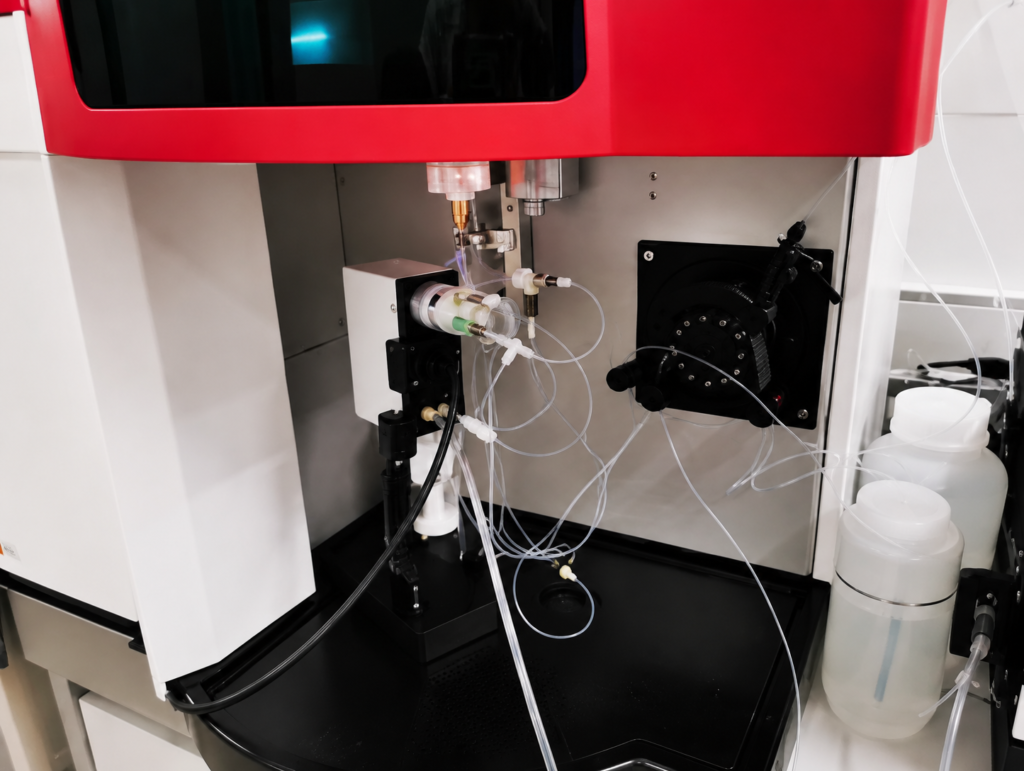
How are lithium ore samples prepared using microwave digestion and hydrofluoric‑acid complexation?
All laboratory equipment is cleaned with high‑purity water before use, and certified reference materials (OREAS 750, OREAS 753 and OREAS 999) are processed in duplicate to verify accuracy. In Procedure A, approximately 0.1 g of sample is digested with concentrated sulphuric acid, hydrofluoric acid, hydrochloric acid and nitric acid; the mixture is left to react before being subjected to stepwise heating (up to 240 °C) in a speedwave XPERT microwave digestion system, diluted to 50 mL and centrifuged.
Procedure B follows the same digestion but, after cooling, adds saturated boric acid to complex any remaining hydrofluoric acid; the mixture is reheated at 180 °C, cooled, diluted and centrifuged. The complexation step prevents formation of insoluble fluoride precipitates and improves recovery of certain elements.
What calibration strategies and instrument settings are used in the PlasmaQuant 9100 Elite analysis of lithium ores?
Quantitative measurements are performed using external calibration curves prepared from single‑element and multi‑element stock solutions in 1 % nitric acid. At least three calibration standards are chosen for each element based on expected concentration ranges, and separate quality‑control standards prepared from different stock solutions monitor accuracy. The PlasmaQuant 9100 Elite uses a sample introduction system resistant to hydrofluoric acid, with radial, axial and radial PLUS plasma views for optimal sensitivity.
Typical settings include 1250 W radio‑frequency power, plasma gas flow of 13 L min⁻¹, auxiliary gas flow of 0.5 L min⁻¹ and nebuliser gas flow of 0.6 L min⁻¹. A parallel‑path nebuliser and cyclonic spray chamber handle the high‑matrix samples, while attenuation modes extend the linear range when measuring major elements alongside trace elements.

What detection and quantification limits were achieved for trace and major elements?
Limits of detection (LOD) are calculated according to ISO 11885 by multiplying three times the standard deviation of blank measurements. Instrumental LODs for the PlasmaQuant 9100 Elite range from the low µg L⁻¹ for elements such as beryllium (0.20 µg L⁻¹) and chromium (0.12 µg L⁻¹) up to ~28 µg L⁻¹ for potassium. After accounting for the dilution factor of the digestion procedure, method‑specific LODs range from 0.01 mg kg⁻¹ for strontium to 14.06 mg kg⁻¹ for potassium. For lithium, the instrumental LOD is 0.90 µg L⁻¹ and the corresponding method LOD is 0.45 mg kg⁻¹ with a limit of quantification (LOQ) of 1.35 mg kg⁻¹. These low detection limits enable quantification of both major and trace elements within a single analytical run.
How does hydrofluoric‑acid complexation impact elemental recoveries in lithium‑ore analysis?
Recoveries for most analytes are comparable whether or not hydrofluoric acid is complexed with boric acid, but significant differences appear for aluminium, arsenic, calcium, caesium, gallium, magnesium, strontium, vanadium and tungsten. In these cases the complexation step (Procedure B) yields higher recoveries because it prevents formation of insoluble fluoride precipitates and stabilises fluoride‑sensitive elements in solution.
For example, aluminium recoveries increased from 63 % to 93 % in OREAS 750 and from 28 % to 100 % in OREAS 753 when boric acid was added. Conversely, spectral interferences arising from the boric acid matrix can cause overestimation of arsenic, gallium and vanadium, indicating that the most suitable procedure depends on the specific elements being targeted.

Why is high‑resolution ICP‑OES crucial for analysing geological materials?
Geological sample digests often contain high concentrations of alumina, silica, iron, sulfur and refractory metals, generating a dense array of emission lines. Detecting low‑level pathfinder elements without excessive dilution requires a robust plasma and high spectral resolution. The PlasmaQuant 9100 Elite provides 2 pm resolution at 200 nm, allowing even severe spectral overlaps to be resolved without mathematical corrections. Long‑term stability tests showed that quality‑control standards remained within ±10 % over a 12‑hour sequence, with relative standard deviations below 6.2 %, demonstrating the instrument’s stability for routine operation. Spike recovery experiments (0.1 mg L⁻¹ added to OREAS 750) produced recoveries within ±20 % for all analytes, confirming the method’s accuracy at low concentration levels.
What conclusions were drawn about the PlasmaQuant 9100 Elite method for lithium‑ore analysis?
The study demonstrates that a high‑resolution ICP‑OES coupled with microwave digestion can accurately and simultaneously determine major, trace and pathfinder elements in lithium ores. DualView PLUS observation allows high‑concentration elements and trace elements to be quantified in a single run without multiple dilutions. Lithium can be measured directly in undiluted samples using the sensitive 670 nm line, while attenuation modes prevent detector saturation for major elements.
Microwave digestion simplifies sample preparation for all elements, but adding a boric‑acid complexation step improves recoveries for fluoride‑sensitive elements. Overall, the combination of the PlasmaQuant 9100 ICP‑OES and the speedwave XPERT digestion system meets the requirements for sensitivity, stability and accuracy necessary for routine lithium‑ore analysis.
What to do next?
To learn more about how high‑resolution ICP‑OES can streamline your lithium‑ore analysis, explore SciMed’s range of PlasmaQuant 9100 instrumentation and speedwave XPERT microwave digestion systems. Our specialists can advise on configuring DualView PLUS for your samples and discuss accessories such as HF‑resistant sample introduction kits and autosamplers. You can also request a live demonstration or arrange for sample testing with your own materials to see how the system performs. Contact SciMed’s team today to discuss your analytical requirements and find the right equipment for your laboratory.
Page FAQ's
The method measures major elements such as aluminium, iron, lithium, sodium, potassium, magnesium and phosphorus, as well as trace and pathfinder elements including beryllium, caesium, rubidium, tantalum and vanadium. DualView PLUS enables detection across a wide concentration range, from sub‑µg L⁻¹ to percent levels.
Microwave digestion accelerates the decomposition of silicate‑rich ores, reduces acid volumes and provides better control over reaction conditions. The speedwave XPERT system performs stepwise heating up to 240 °C, producing clear solutions ready for analysis. Adding a boric‑acid complexation step further improves recoveries for elements susceptible to fluoride precipitation.
The instrumental limit of detection for lithium is 0.90 µg L⁻¹, corresponding to a method detection limit of 0.45 mg kg⁻¹ after accounting for sample dilution. The method limit of quantification is 1.35 mg kg⁻¹.
No. Most analytes show similar recoveries with or without the complexation step, but adding boric acid (Procedure B) is recommended for aluminium, calcium, magnesium, caesium, strontium, vanadium and tungsten because it prevents formation of insoluble fluoride precipitates and stabilises fluoride‑sensitive elements.
Contact Us Today
We take great pleasure in assisting you and ensuring you get a prompt response to your questions
Live chat opening hours Mon – Fri 9:15 to 16:30 (UK Time)