
SciMed Education
Online Measurement of Lithium in Brine Samples Using HR‑ICP‑OES and the PlasmaQuant 9100 Elite
Introduction
Continuous online monitoring of lithium concentration in high‑salt brine samples is achieved using a high‑resolution ICP‑OES instrument (PlasmaQuant 9100 Elite) equipped with a high‑salt kit. The method uses matrix‑matched calibration and dual‑view optics to provide real‑time analysis every 30 seconds, ensuring precise measurement of lithium across a wide concentration range.
Why is online analysis of lithium in brine samples important for lithium recovery?
Lithium‑ion batteries have transformed portable electronics and are enabling electric vehicles and grid‑scale energy storage. Lithium is relatively rare in the Earth’s crust and is often extracted from highly saline brine deposits in regions such as the “lithium triangle” of South America.
Continuous monitoring of lithium concentration during brine processing provides real‑time information about adsorption kinetics and helps minimise the risk of incorrect assessment during extraction. Real‑time data are especially valuable because the lithium content of a brine stream can vary widely and rapid feedback enables optimisation of recovery processes.

What challenges arise when measuring lithium in brine samples with high total dissolved solids (TDS)?
Brine samples can contain up to 300 g L⁻¹ of sodium chloride and other dissolved salts, leading to extremely high TDS. Such matrices destabilise the plasma in conventional ICP‑OES instruments and can cause blockages in the nebuliser and torch injector. High salt levels also require rapid analysis to capture changes in lithium concentration and a wide dynamic range to cover trace and high levels during a single run. Without robust sample introduction and stable plasma conditions, precision suffers and maintenance intervals increase.
How does the PlasmaQuant 9100 Elite HR‑ICP‑OES perform online measurement of lithium in brine samples?
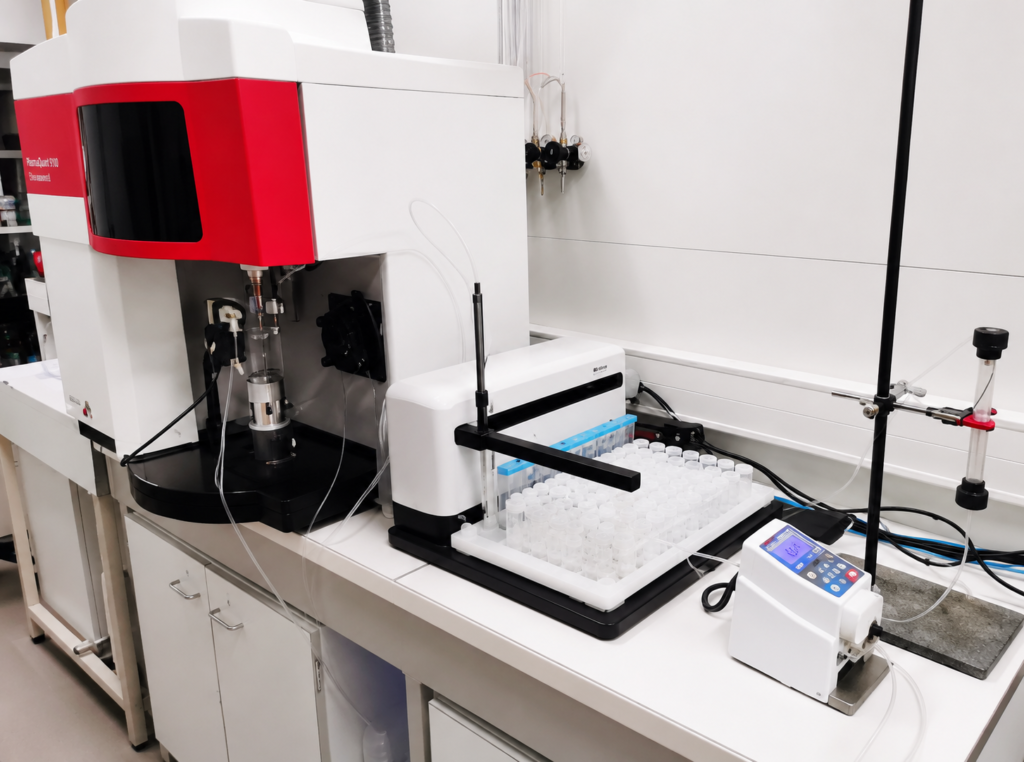
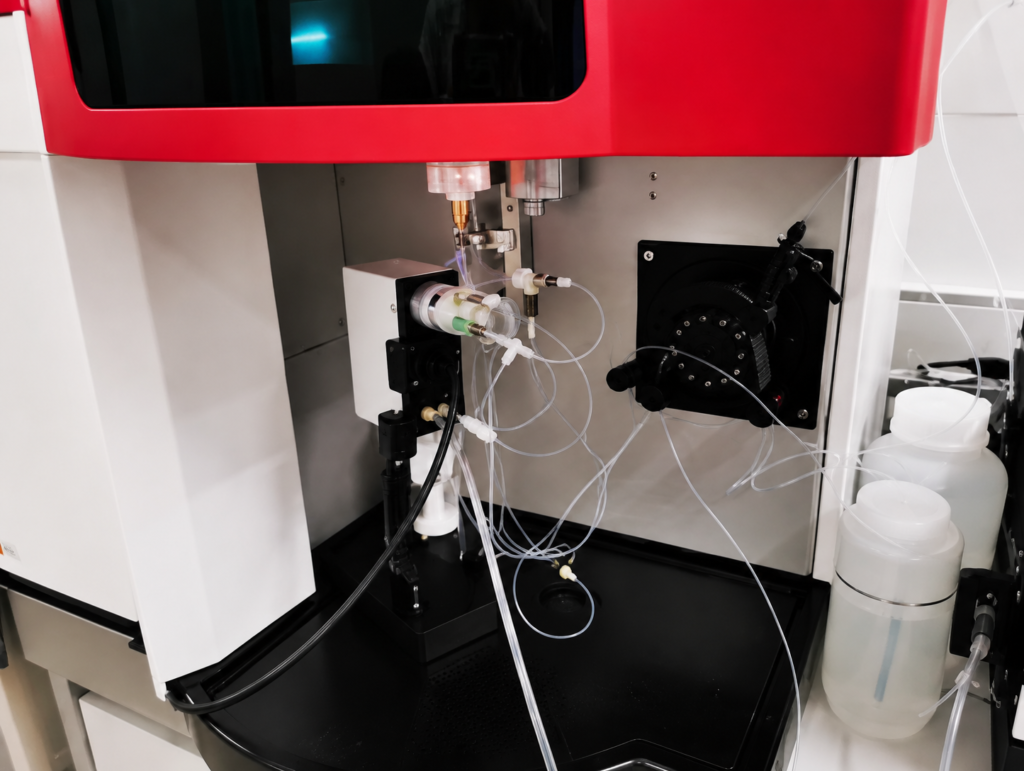
The PlasmaQuant 9100 Elite HR‑ICP‑OES is configured with a high‑salt kit (SeaSpray™ concentric nebuliser, double‑pass cyclonic spray chamber and alumina/Syalon torch) and a 6‑port injection valve to achieve high sample throughput. An external peristaltic pump and argon humidifier continuously renew the brine sample on the autosampler and minimise blockages. The instrument’s exceptionally high optical resolution allows interference‑free detection of lithium at 670.971 nm in undiluted brine matrices up to 300 g L⁻¹ NaCl. With a measurement cycle of 30 seconds (including uptake, analysis and rinse), the system provides real‑time monitoring of lithium adsorption kinetics.
What are the sample preparation and calibration methods for lithium in brine samples?
No sample preparation is required—brine containing up to 300 g L⁻¹ NaCl can be analysed directly. A matrix‑matched calibration is used to avoid matrix effects; standard solutions prepared from a 1 000 mg L⁻¹ lithium stock are added to the brine solution. Two calibration curves are employed to cover the full dynamic range of lithium concentrations: one from 0.05–0.5 mg L⁻¹ measured axially and a second from 10–100 mg L⁻¹ measured in an attenuated radial view. Both calibrations use the Li emission line at 670.971 nm.
What instrument settings and accessories are used to handle high‑salt matrices?
The instrument operates at an RF power of 1 400 W, with plasma, auxiliary and nebuliser gas flows of 15 L min⁻¹, 1 L min⁻¹ and 0.6 L min⁻¹ respectively. The sample is introduced using a SeaSpray™ concentric nebuliser, a cyclonic spray chamber and an alumina/Syalon torch; pump tubing diameters are selected to achieve a 5‑fold dilution. A Cetac ASXPress Plus injection valve with a 0.7 mL loop accelerates sample throughput. The argon humidifier prevents salt deposits from blocking the nebuliser, enabling long‑term operation. This configuration supports continuous analysis of undiluted brine at 300 g L⁻¹ NaCl without plasma instability.
How does the method ensure precision, sensitivity and a wide dynamic range for lithium analysis?
The PlasmaQuant 9100 Elite’s high‑resolution optics (2 pm at 200 nm) allow interference‑free detection and simultaneous measurement using axial and attenuated radial views. By combining two calibration curves, the method covers lithium concentrations from 0.05 mg L⁻¹ to 100 mg L⁻¹. In a precision test, nine consecutive measurements of lithium in brine produced a mean concentration of 0.0285 mg L⁻¹ with a relative standard deviation (RSD) of 0.51 %. The method detection limit (MDL), calculated from repeated measurements (n = 11) of a 300 g L⁻¹ brine sample, was 0.3 µg L⁻¹, demonstrating the instrument’s high sensitivity. Because the instrument can attenuate the signal in both axial and radial observations (DualView Plus), it can quantify trace and high lithium concentrations within the same run.
Why is the PlasmaQuant 9100 Elite suitable for undiluted brine samples and what other applications could use this setup?
Unlike many ICP‑OES systems, the PlasmaQuant 9100 Elite can analyse undiluted saline samples due to its robust plasma and high‑resolution optical system. The dedicated high‑salt introduction kit and humidifier allow continuous measurements without blockages. The same setup could be applied to other high‑matrix samples, such as wastewater monitoring or online process control, where rapid, precise determination of dissolved elements is required. The instrument’s dual‑view capability and wide dynamic range make it suitable for quantifying both trace and major elements in various industries.

What to do next?
If you would like to learn more about online measurement of lithium in brine or to discuss how high‑resolution ICP‑OES can improve your lithium recovery processes, please contact SciMed’s specialist team. We can provide detailed application notes, arrange product demonstrations of the PlasmaQuant 9100 Elite and advise on the best configuration for your application. Visit our product page to explore the full range of HR‑ICP‑OES instruments or get in touch via phone or email for expert advice.
Page FAQ's
Using dual calibration curves, the method quantifies lithium from as low as 0.05 mg L⁻¹ to as high as 100 mg L⁻¹. The detection limit is approximately 0.3 µg L⁻¹.
The system completes a full cycle—including uptake, analysis and rinse—in 30 seconds, providing a new lithium concentration every half minute.
Matrix‑matched calibration ensures that the standard solutions contain the same salt content as the samples, avoiding matrix effects and yielding accurate results.
Its robust high‑frequency plasma, high‑resolution optics and dedicated high‑salt introduction kit allow the instrument to handle undiluted brine up to 300 g L⁻¹ NaCl while maintaining precision and low detection limits.
Contact Us Today
We take great pleasure in assisting you and ensuring you get a prompt response to your questions
Live chat opening hours Mon – Fri 9:15 to 16:30 (UK Time)