
SciMed Education
Flow Properties of Powders and Bulk Solids – Silo Design and Ring Shear Testing
In Summary
The flow behaviour of powders and bulk solids determines whether materials can be discharged from hoppers and silos or will instead form bridges, arching or rat holes. Flowability is commonly defined using the ratio of consolidation stress to the unconfined yield strength (often written as ffc=s1/scf_{fc} = s_1/s_cffc=s1/sc), and powders are ranked from non‑flowing to free‑flowing based on this ratio. Good flowability means the powder can be easily set to flow, whereas poor flowability leads to arching, piping or caking during storage.
Measuring these parameters under defined stress conditions requires a shear tester. Ring shear testers provide accurate flow functions, wall friction and bulk density data, which are critical for silo design and process optimisation. They also help engineers differentiate between mass flow and funnel flow and design hoppers that avoid flow problems.
What Are the Flow Properties of Powders of Bulk Solids and How Do They Influence Flowability?
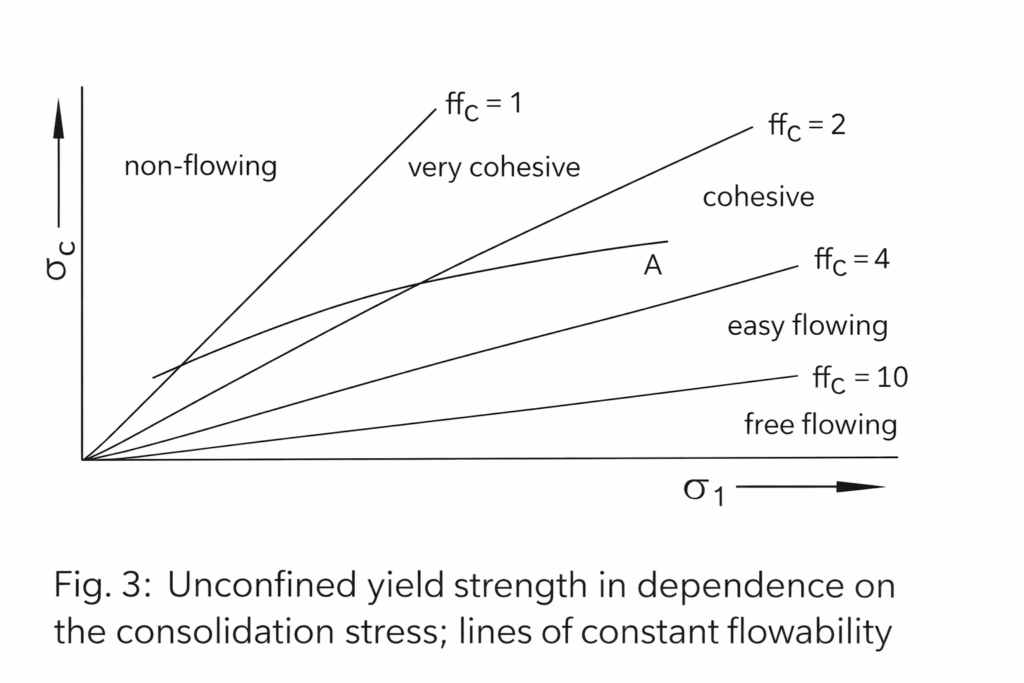
Powder flowability describes how easily a bulk solid can be made to flow. The reference method for powder flow is the Shear Test. This approach quantifies flowability by measuring the consolidation stress acting on a powder in storage and the unconfined yield strength needed for the material to fail and start flowing. The flowability ratio ffcf_{fc}ffc compares these values, with lower ratios indicating poor flow and higher ratios indicating free‑flowing behaviour.
Materials with ffc<1f_{fc}<1ffc<1 are classified as non‑flowing, those between 1 and 2 are very cohesive, values between 2 and 4 signify cohesive powders, ratios between 4 and 10 are described as easy‑flowing and materials with ffc>10f_{fc}>10ffc>10 are considered free‑flowing. A powder with good flowability can be easily set in motion, whereas poor flowability leads to problems such as arching or caking during discharge.
How Is Powder Flowability Defined and Categorised?
The unconfined yield strength (Sigma 1) of a bulk solid increases with the consolidation stress (SigmaC) applied during storage. A typical flow function plots scs_csc versus s1s_1s1, and the gradient of this curve determines the flow function. Because the ratio ffc=s1/scf_{fc}=s_1/s_cffc=s1/sc changes with the consolidation stress, comparative tests require measurement devices that can apply defined consolidation stresses and measure the corresponding yield strength.
Shear testers, particularly ring shear testers, are designed for this purpose. By measuring flow functions at different stress levels, users can determine whether a powder will behave as non‑flowing, cohesive or free‑flowing under the expected storage conditions.
What Is Unconfined Yield Strength and Why Does It Matter for Bulk Solids Flowability?
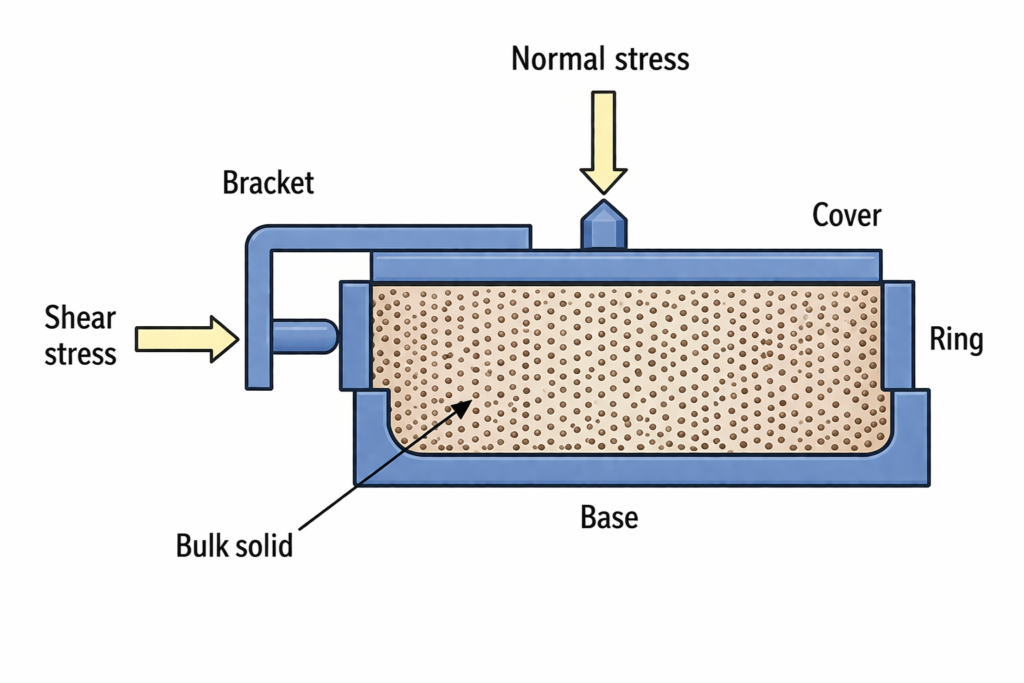
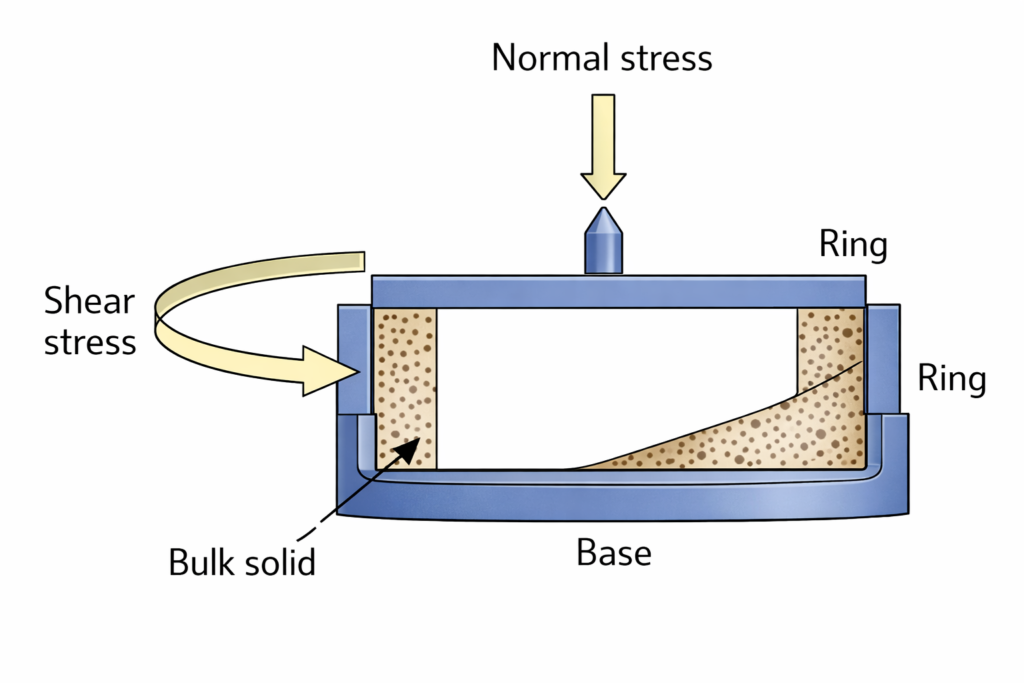
Unconfined yield strength refers to the compressive stress at which a powder sample fails and starts to flow. In the ring shear test, a bulk solid is first consolidated under a known vertical shaped test cell; this is also called pre-shear; the sample then subjected to increasing compressive stress until it breaks. The measured stress at failure is the unconfined yield strength scs_csc.
Powders with high scs_csc relative to their consolidation stress resist flow and may form stable arches or pipes during discharge. By understanding how scs_csc varies with consolidation stress, engineers can predict whether a powder will flow freely or require special handling and can select hopper geometries that minimise flow problems.
What Is a Ring Shear Tester and How Does It Measure Flow Properties of Powders and Bulk Solids?
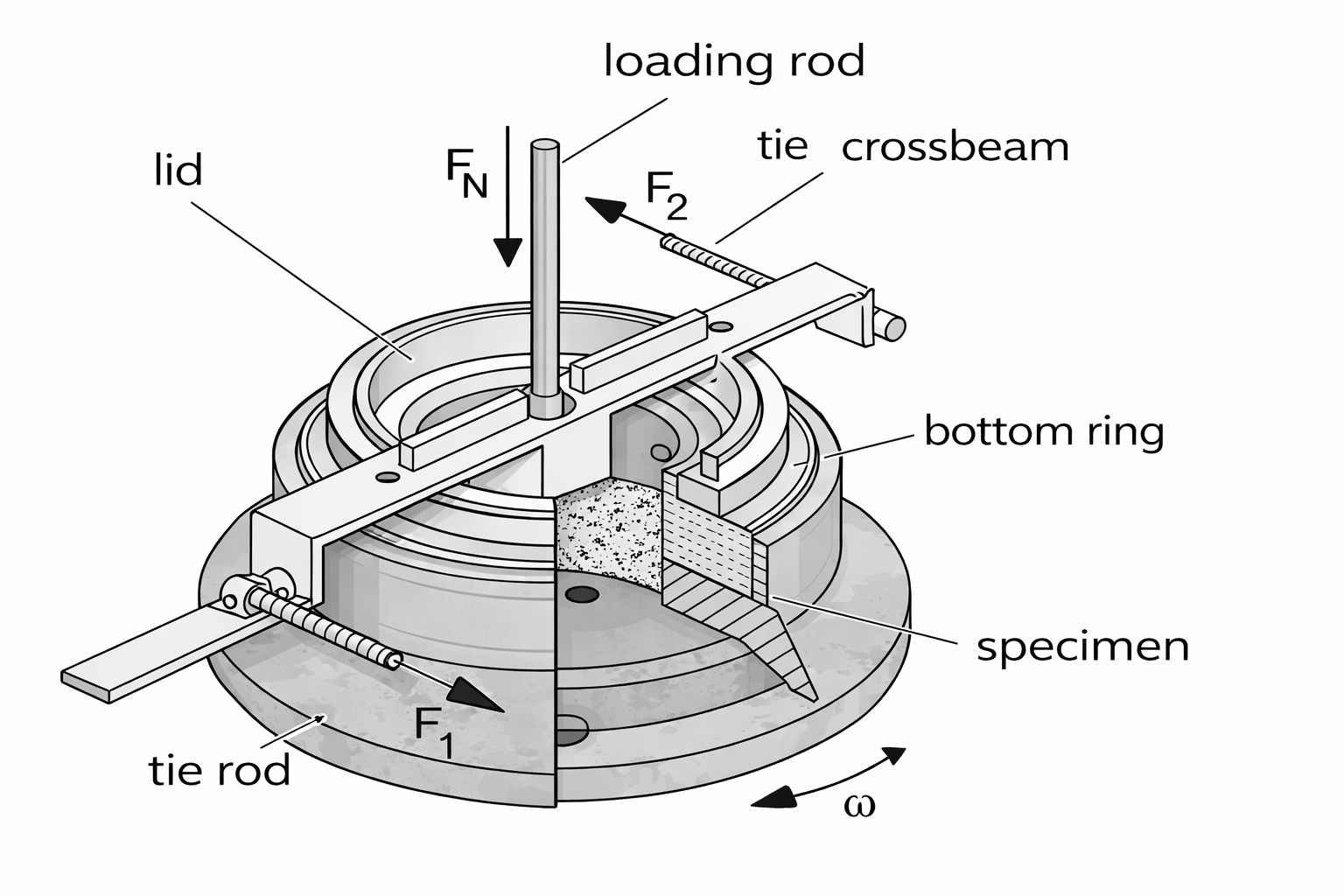
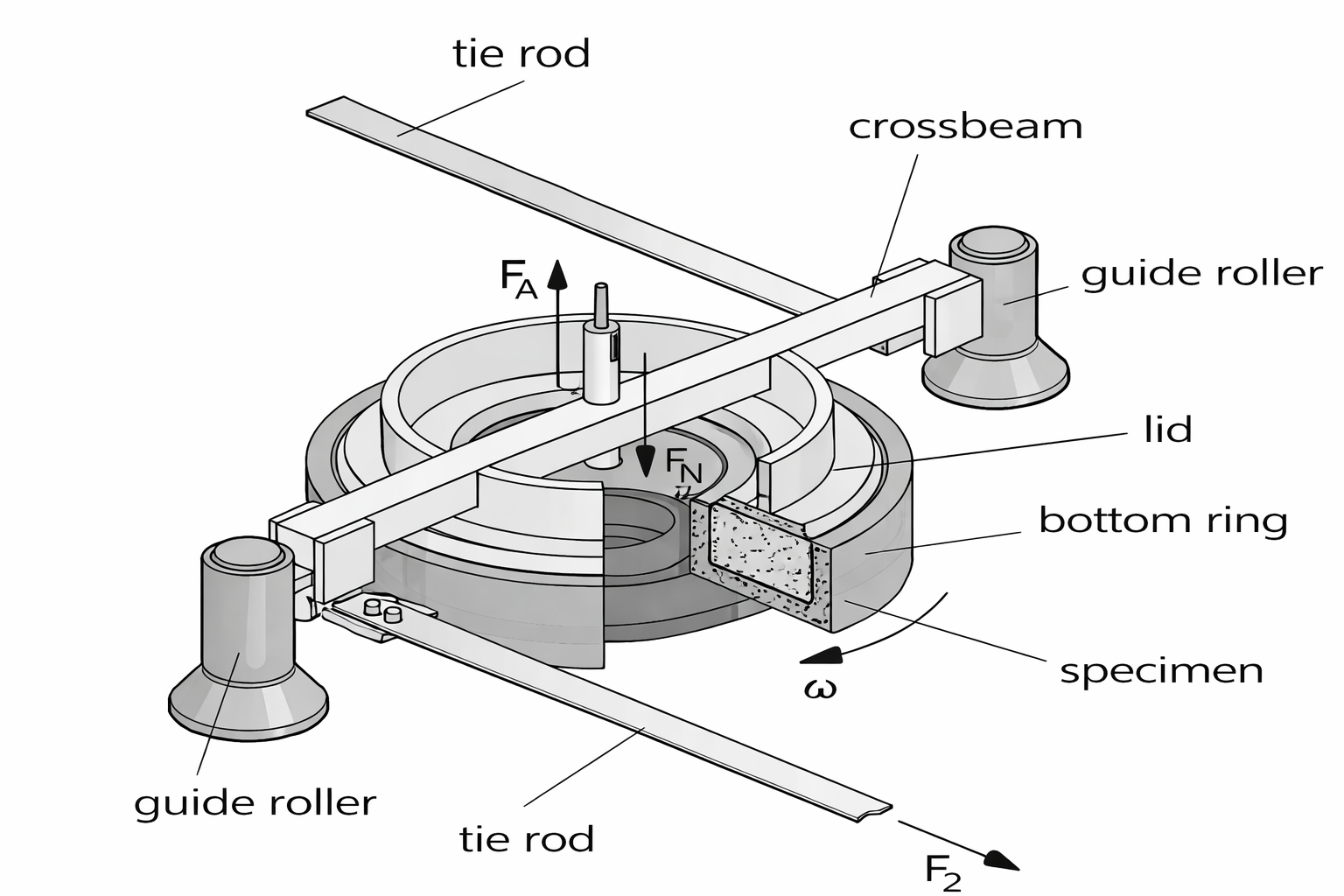
Ring shear testers are specialised instruments that measure powder flow properties under controlled stress conditions. Typical ring shear testers, such as the RST‑01.0, RST‑01.pc and RST‑XS, consist of an annular shear cell filled with the bulk solid and loaded from above with a vertical force. During testing, the shear cell is rotated slowly while the cover is held stationary by tie rods; the forces measured in the tie rods allow calculation of shear stress and normal stress.
From a prescribed test procedure, ring shear testers provide quantitative data on flowability, caking behaviour, bulk density and wall friction. Advanced versions (e.g., RST‑01.pc and RST‑XS) automate specimen loading, shearing and data evaluation, making powder flow testing more efficient. Because they operate over a range of stress levels and produce reproducible flow functions, ring shear testers are more reliable than simple flowability testers.
CLICK TO VIEW IMAGES
What Flow Problems Occur in Silo Storage – Arching, Piping, Irregular Flow, Flooding and Segregation?
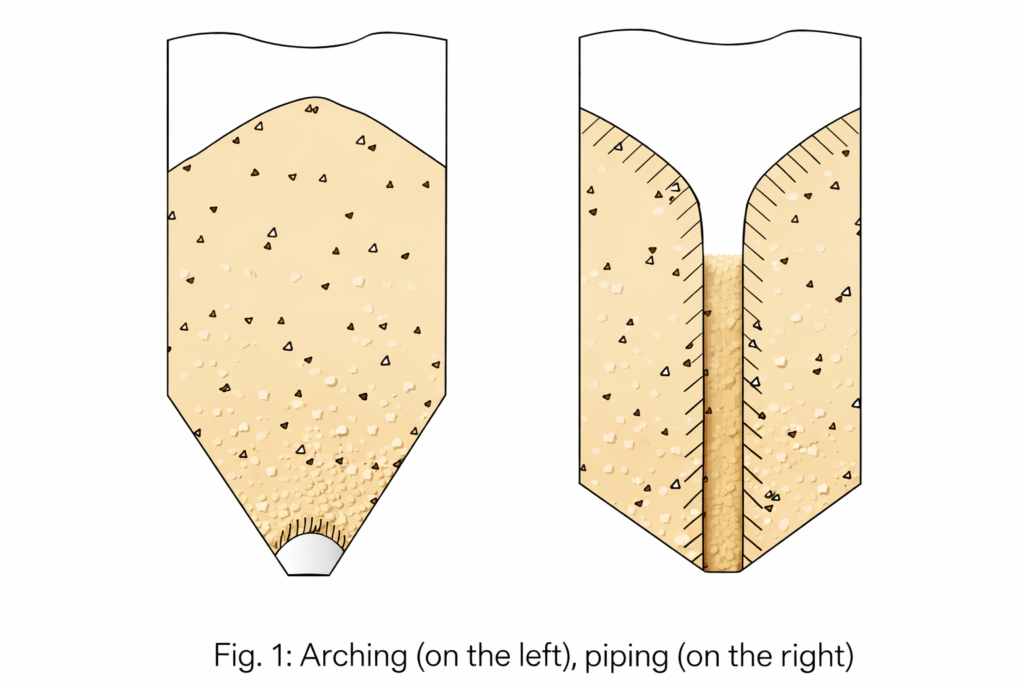
When powders are stored in silos or hoppers, poor flowability can lead to several problems. Non‑flowing materials may build up stable arches or pipes at the outlet, preventing discharge. Other common issues include irregular flow or sudden flooding, where material unexpectedly surges out of the silo; broad residence‑time distributions caused by dead zones where material remains stagnant; and segregation due to differences in particle size, density or shape, which results in an inconsistent product at the outlet.
These problems are particularly severe in silos exhibiting funnel flow, where material in the centre flows while material near the walls remains stationary.
What Are Mass Flow and Funnel Flow in Silo Design and How Do They Compare?
Two basic flow patterns can occur when a silo discharges: mass flow and funnel flow. In mass flow, every particle within the silo moves when the outlet is opened; this uniform motion reduces segregation and ensures a consistent residence time distribution. In funnel flow, only the material in the centre of the silo moves, while material near the walls remains stagnant, creating dead zones. Funnel flow is the primary cause of flow problems such as arching, piping and segregation.
Designing a silo for mass flow requires determining the minimum outlet dimension and hopper wall steepness needed to prevent arching and to maintain continuous flow. Accurate flow property data from a shear tester are essential for calculating these design parameters.
How Do Ring Shear Testers Help with Silo Design and Flow Optimisation?
Ring shear testers provide the quantitative data required to design silos that promote mass flow and avoid flow problems. By measuring flow functions, wall friction and bulk density at different stress levels, engineers can calculate the critical outlet size and hopper wall angles required to prevent arching. These parameters are used in hopper design models to ensure that the powder discharges uniformly and does not cake or segregate.
With sufficient experience, the data from ring shear testing enable not only the design of new silos but also the redesign of existing silos that are not working properly. Because ring shear testers measure clearly defined physical quantities and can operate automatically, they are an advantageous alternative to simple flowability testers.
Why Choose Ring Shear Testers Over Simple Flowability Testers?
Simple flowability testers may provide qualitative assessments of powder flow, but they do not measure the fundamental physical quantities required for accurate silo design. Ring shear testers measure the unconfined yield strength, wall friction, compressibility and bulk density under controlled stress conditions. They also operate at different stress levels and can automatically load specimens, shear the sample and evaluate the results.
The ability to obtain reproducible flow functions makes ring shear testers a superior tool for process development, quality control and troubleshooting in industries that handle powders and bulk solids. As an easy‑to‑operate instrument that nonetheless produces clearly defined data, the ring shear tester is considered an advantageous alternative to simple flowability testers.
What to Do Next?
Understanding powder flow behaviour is essential for efficient handling, processing and storage. If you need to design or optimise hoppers, predict flowability or prevent issues such as arching and segregation, SciMed can help. We supply the Schulze Ring Shear Tester RST‑XS.s, an advanced automatic ring shear tester that provides comprehensive powder flow characterisation, including flow functions, wall friction and bulk density measurements. Its small sample requirement and integrated RST‑CONTROL 95 software make it ideal for industries ranging from pharmaceuticals to bulk powder processing. Discover the RST‑XS.s and explore how it could improve your powder handling processes.
Page FAQ's
he flowability ratio ffcf_{fc}ffc is the ratio of consolidation stress to unconfined yield strength. Materials with ffc<1f_{fc}<1ffc<1 are non‑flowing, between 1 and 2 are very cohesive, 2–4 are cohesive, 4–10 are easy‑flowing and above 10 are free‑flowing.
Arching and piping occur when a powder’s unconfined yield strength is high relative to the consolidation stress, allowing stable arches or pipes to form above the outlet. Poor flowability and funnel flow patterns exacerbate these problems.
In funnel flow, only the material in the centre of the silo moves while material near the walls remains stagnant, leading to dead zones, segregation and flow interruptions. Mass flow moves all particles uniformly, so the only potential problem is arching.
Ring shear testers measure flow functions, wall friction and bulk density at defined stress levels. These data allow engineers to calculate the minimum outlet size and hopper wall angle required for mass flow, enabling the design or redesign of silos that discharge reliably.
Automatic ring shear testers such as the RST‑01.pc and RST‑XS automate specimen loading, shearing and data evaluation. They provide well‑defined physical measurements over a range of stress levels and are easy to operate, making them a robust alternative to simple flowability testers.
Contact Us Today
We take great pleasure in assisting you and ensuring you get a prompt response to your questions
Live chat opening hours Mon – Fri 9:15 to 16:30 (UK Time)