
SciMed Education
Silo Design, Flow Problems and Ring Shear Testing
In Summary
Poor flowability of powders and bulk solids can cause serious problems when materials are stored or discharged from hoppers and silos. When only the material in the centre of a silo flows while material near the walls remains stagnant (a pattern known as funnel flow), the powder may form stable arches or pipes at the outlet and cause irregular flow, flooding, long residence times or segregation.
Designing silos for mass flow—where all particles move uniformly—minimises these issues; however, engineers must determine the hopper wall angle and outlet dimensions needed to prevent arching. Ring shear testers provide the quantitative flow properties required to design hoppers and silos for mass flow.
What Flow Problems Can Occur During Storage of Bulk Solids in Silos?
When bulk solids with poor flowability are stored in silos, several distinct problems can arise. Arching occurs when the material forms a stable bridge above the outlet, completely blocking discharge. Piping refers to the formation of a central channel through which powder flows while material around it remains stationary.
Other issues include irregular flow and flooding, where powder suddenly surges from the silo, broad residence time distributions due to dead zones near the walls, and segregation when differences in particle size, density or shape cause the composition at the outlet to vary. These problems are most severe when a silo exhibits funnel flow.
What Is Funnel Flow and Why Is It Problematic?
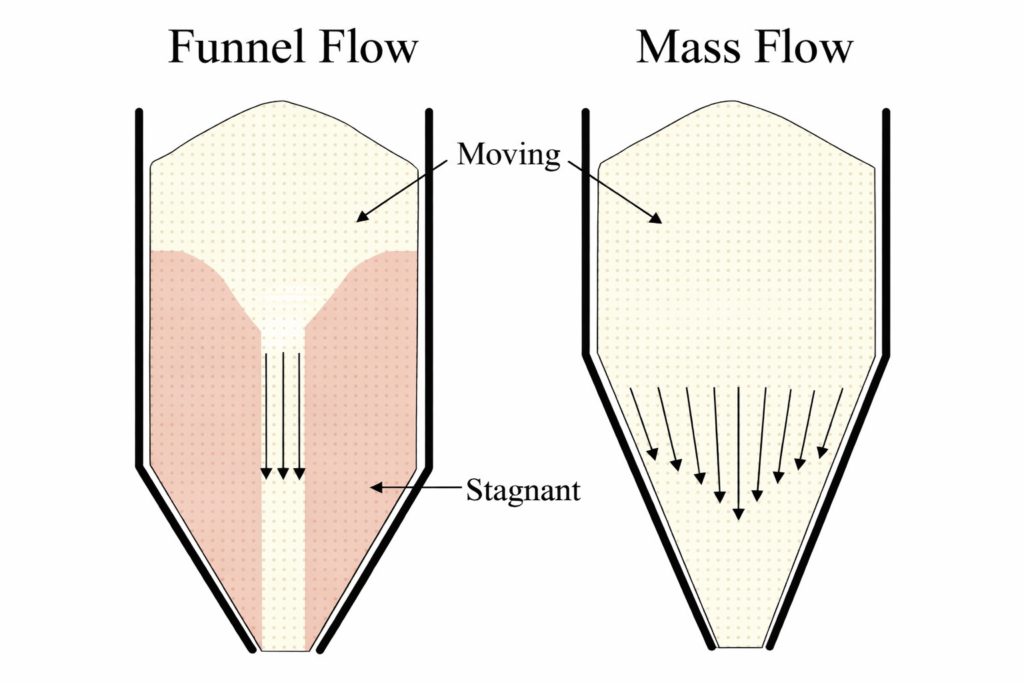
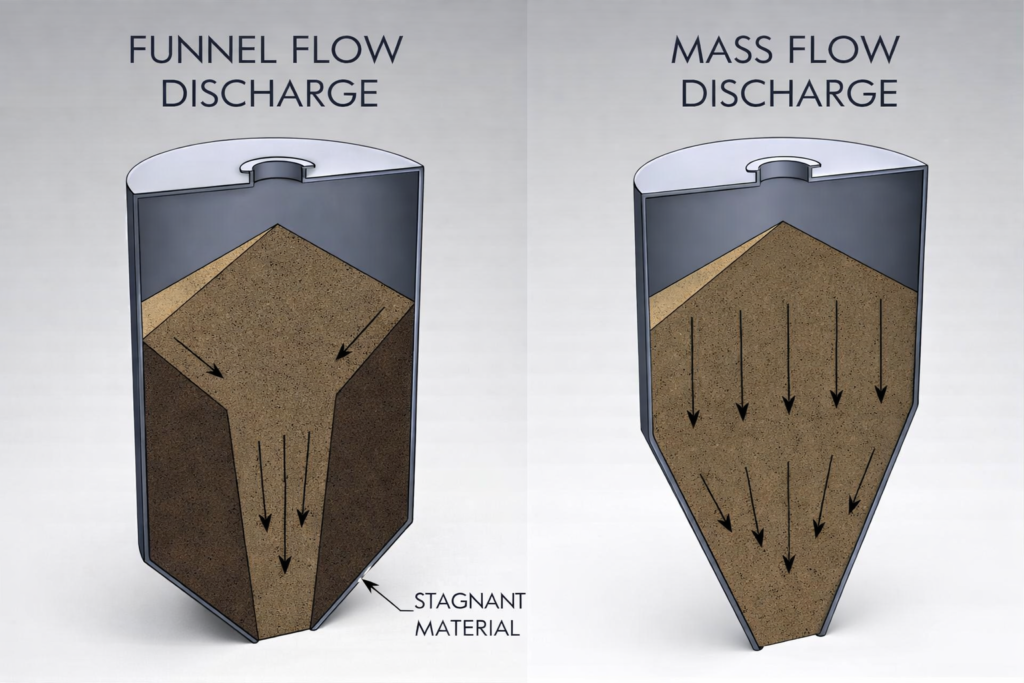
Funnel flow is a discharge pattern in which only the bulk solid in the centre of the silo moves, while material near the walls remains stagnant. This stagnation leads to dead zones where powder can remain for long periods, resulting in caking, ageing or decomposition. Funnel flow is the primary cause of arching, piping, irregular discharge and segregation.
In funnel‑flow silos, the product composition at the outlet may change over time as coarse or dense particles preferentially migrate to the centre and fine or light particles remain in the dead zones. Because the flow channel narrows above the outlet, the vertical stress on the powder may drop below its unconfined yield strength, allowing stable arches or pipes to form.
How Does Mass Flow Differ from Funnel Flow and What Are Its Advantages?
In mass flow, every particle within the silo moves when the outlet is opened. There are no stagnant zones; instead, the entire contents slide uniformly towards the outlet. According to the application note, funnel flow causes all of the flow problems listed above, whereas in mass flow only the problem of arching must be considered. Because all material is in motion, mass‑flow silos avoid segregation and flooding and deliver a more uniform product.
Residence times are well defined, which is important for temperature‑sensitive or perishable materials, and caking is minimised because no material is left stagnant against the silo walls.
How Can Proper Silo Design Improve Powder Flow?
To achieve mass flow, the hopper geometry must be designed so that the powder continually yields and flows along the walls. This means determining both the minimum outlet dimension required to prevent arching and the steepness of the hopper walls needed to ensure that material adjacent to the walls shears and moves. Selecting appropriate wall materials or liners with low wall friction may also be necessary.
The design process relies on accurate flow‑property measurements; without them, engineers must rely on experience or trial‑and‑error, leading to oversizing or under‑performing hoppers. The application note emphasises that sufficient experience in the application of flow‑property data allows not only the design of new silos but also the redesign of existing silos that are not working properly.
SciMed offers both the Shear Tester to provide reliable test data which can be used in the modelling of hoppers, bins and silos. Furthermore, the Computer Aided Hopper Design software allows the user to define the critical parameters for a hopper that will deliver mass flow.
Why Are Ring Shear Testers Essential for Silo Design?
Ring shear testers measure the fundamental flow properties—such as unconfined yield strength, wall friction, compressibility and bulk density—that engineers use to calculate critical hopper angles and outlet sizes.
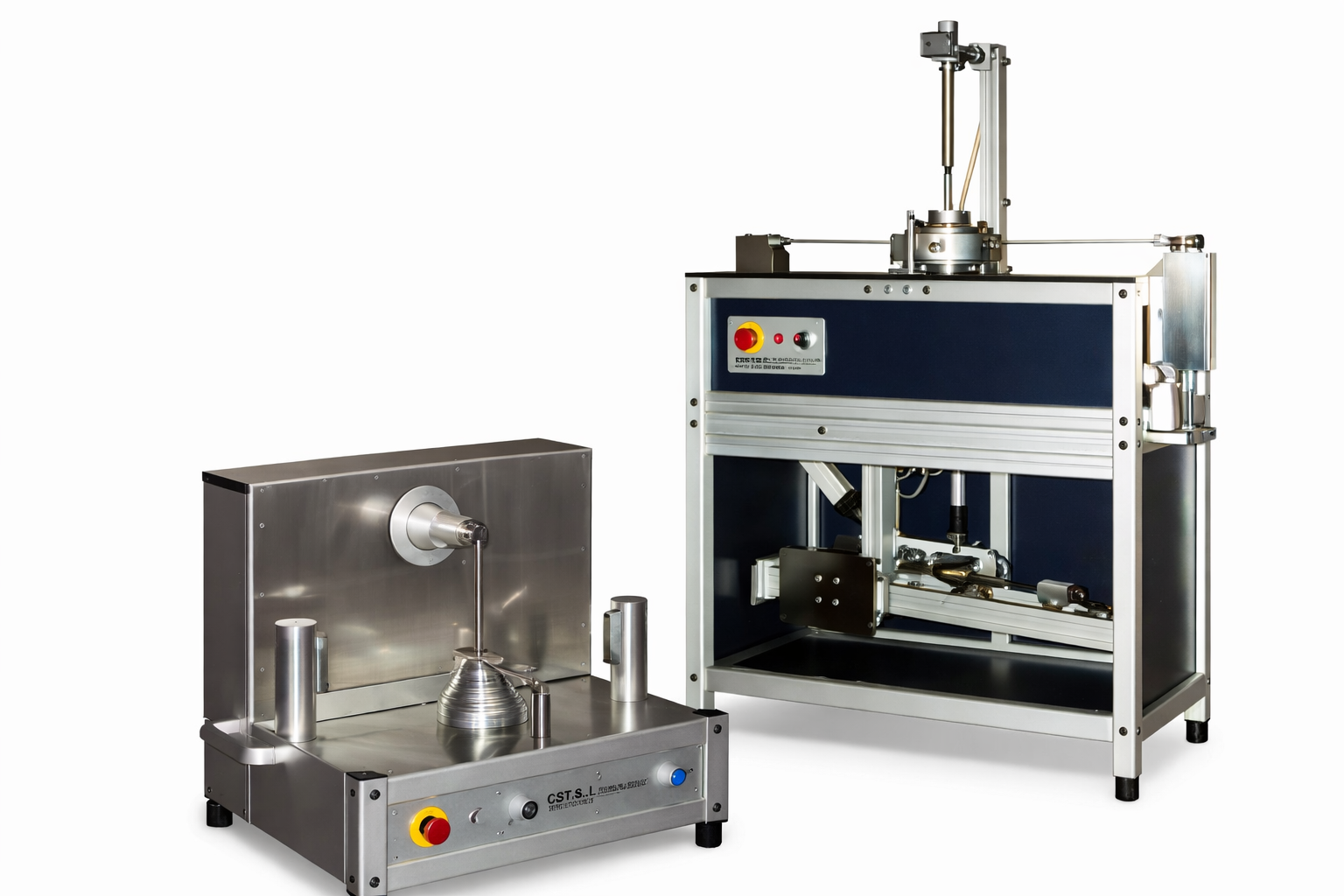
The instrument consists of an annular shear cell filled with the bulk solid and loaded from above with a normal force; during testing, the shear cell rotates slowly while the lid is held stationary by tie rods, allowing shear stress and normal stress to be measured. Advanced models like the RST-MK II and RST-XS.s can automatically load the specimen, apply defined stress levels and evaluate the flow function.
Key advantages of ring shear testers are:
– They measure well‑defined physical quantities (flowability, caking, bulk density),
-They operate over different stress levels and are simple to operate.
– The test is based on solid powder mechanics theory established over 50 years ago by Jenike, Carrs and walker. This is unlike all other powder flow test methods which are empirical
These capabilities make ring shear testers a superior alternative to simple flowability testers when designing hoppers and silos.
What to do Next?
If you are facing flow problems in your silo or hopper, or you need to design a new storage system that delivers consistent, reliable discharge, SciMed can help. We supply the SCHULZE RING SHEAR TESTER RST‑XS.S, an automatic ring shear tester that provides comprehensive flow‑property characterisation. By measuring flow functions, wall friction and bulk density at controlled stress levels, the RST‑XS.s enables you to calculate hopper wall angles and outlet dimensions for mass flow and to troubleshoot existing silos. Explore the RST‑XS.s on our website or contact us for expert advice on powder flow testing.
Page FAQ's
In mass flow, all of the material in a silo moves towards the outlet when discharge begins. In funnel flow, only the material in the centre moves, leaving dead zones near the walls. Funnel flow causes problems such as arching, piping, flooding and segregation, whereas mass flow generally only needs to address arching.
Arches and pipes form when the powder’s unconfined yield strength exceeds the vertical stress in the hopper. Under these conditions, the powder can support a stable bridge or pipe across the outlet. Funnel‑flow silos are particularly prone to arching and piping because stagnant material near the walls lowers the stress on the flowing channel.
Segregation occurs when differences in particle size, density or shape cause certain fractions to migrate preferentially within the flowing channel. Designing for mass flow, selecting appropriate hopper angles and using flow‑property data to ensure uniform shear along the walls help minimise segregation.
- Silo designers use flow functions (unconfined yield strength versus consolidation stress) to determine the outlet dimension required to prevent arching and wall friction measurements to calculate the hopper angle needed for mass flow. Ring shear testers provide both sets of data.
Contact Us Today
We take great pleasure in assisting you and ensuring you get a prompt response to your questions
Live chat opening hours Mon – Fri 9:15 to 16:30 (UK Time)