
SciMed Education
Ultra-Low Phosphorus, Sulfur and Chlorine Analysis in Petrochemicals Using Benchtop WD-XRF
Introduction
Ultra-low-level determination of phosphorus, sulfur and chlorine is a persistent analytical challenge across petrochemical, fuels and lubricant laboratories. As regulatory thresholds tighten and product performance requirements become more demanding, laboratories require techniques that combine sub-ppm sensitivity, reproducibility, and operational efficiency.
Benchtop WD-XRF (Wavelength Dispersive X-ray fluorescence) has emerged as a highly effective solution—particularly for routine, high-throughput environments where traditional methods introduce complexity or limitations.
Why Ultra-Low P, S and Cl Analysis Matters
Regulatory and Performance Drivers
In UK and EU markets, ultra-low elemental analysis is essential for:
• Automotive fuels compliance
Sulfur limits under EN standards (aligned with Euro VII regulations) require concentrations typically below 10 mg/kg.
• Lubricant formulation and monitoring
Phosphorus is widely used in anti-wear additives (e.g. ZDDP) but must be tightly controlled due to catalyst poisoning risks.
• Crude oil and refinery process protection
Chlorine—even at trace levels—can cause:
- Corrosion in distillation units
- Fouling of catalysts
- Damage to downstream infrastructure
As a result, laboratories increasingly need reliable quantification at or below 1 mg/kg (ppm).

Why is Benchtop WD-XRF Well Suited to P, S, Cl analysis?
Benchtop WD-XRF provides a compelling alternative by combining:
• Multi-element capability (P, S, Cl in a single run)
• Minimal sample preparation
• Excellent repeatability at low concentrations
• Non-destructive analysis
Unlike energy dispersive XRF (ED-XRF), WD-XRF offers:
• Higher spectral resolution
• Improved peak separation (critical for light elements like P, S, Cl)
• Lower background noise → better detection limits

Relevant Standards for UK Petrochemical Laboratories
Benchtop WD-XRF methods align well with internationally recognised standards commonly used in UK laboratories:
• ASTM D2622-16 –
Sulfur in petroleum products by WD-XRF
• ISO 20884 –
Sulfur in automotive fuels by WD-XRF
While chlorine and phosphorus may not always have dedicated WD-XRF standards in the same way.
Laboratories often develop validated in-house methods aligned with:
• Internal QA/QC protocols
• Certified reference materials (CRMs)
• Industry guidance (e.g. refinery or OEM specifications)
The companion application note demonstrates that WD-XRF performance can meet or exceed the precision requirements defined in ASTM and ISO Sulfur methods even at very low concentrations.
A copy of Rigaku WDXRF Application note #1072 – Ultra Low P, S, Cl Analysis in Liquids with a Benchtop WDXRF Spectrometer can be issued upon request
WD-XRF Methodology for Ultra-Low Elemental Analysis
How does Benchtop WD-XRF Work?
Key Performance Capabilities
WD-XRF measures characteristic X-ray wavelengths emitted by elements when excited by an X-ray source.
For ultra-low P, S and Cl:
• Specific emission lines are targeted:
• P-Kα
• S-Kα
• Cl-Kα
• High-resolution analysing crystals isolate each wavelength
• Detectors measure intensity proportional to concentration
Based on application data:
• Detection limits (LLD): ~0.1 mg/kg for P, S, Cl
• Calibration ranges:
• Phosphorus: up to ~75 mg/kg
• Sulfur: up to ~12 mg/kg
• Chlorine: up to ~11 mg/kg
Precision:
• Sub-ppm repeatability demonstrated at 0.5–5 mg/kg levels
• Meets ASTM D2622 and ISO 20884 reproducibility criteria
Sample Preparation: Simple and Reproducible
One of the key advantages of WD-XRF is its simplicity:
Typical workflow:
• Pipette ~15g of liquid sample into an XRF sample cup
• Seal with thin polymer film (~4 µm)
• Load directly into the spectrometer
No digestion, combustion, or dilution is required.
Best practice considerations:
• Use clean sample cups and films to avoid contamination
• Wipe components with solvent (e.g. ethanol) prior to use
• Maintain consistent sample thickness and volume

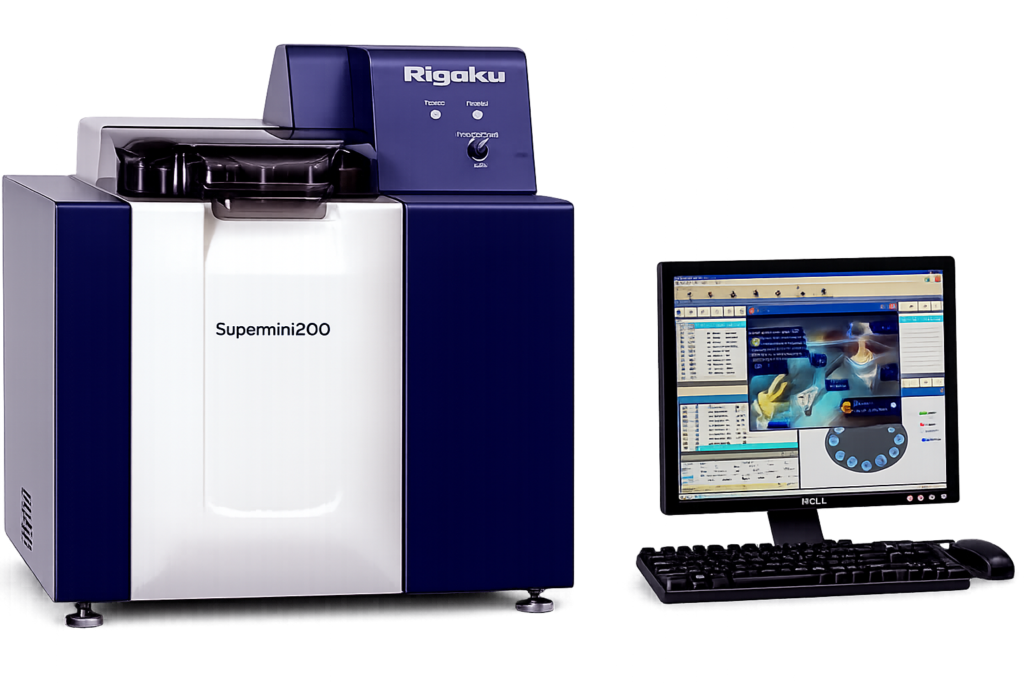
Recommended Instrument: RIGAKU Supermini 200
The RIGAKU Supermini 200 benchtop WD-XRF is particularly well suited for ultra-low Phosphorus, Sulfur and Chlorine analysis in petrochemical applications.
Key Advantages
• Optimised crystal configuration (RX9) for trace P, S, Cl detection
• Detection limits down to ~0.1 mg/kg
• Excellent short- and long-term stability without drift correction
• Compact, ‘true’ benchtop design:
• No cooling water required
• No special power infrastructure
• Air-cooled 200 W X-ray tube
• Multi-element capability (O to U)
Operational Benefits
• Minimal consumables (no acids or combustion gases)
• Rapid analysis (results in minutes)
• High throughput capability for routine labs
• Shared software platform with high-end WD-XRF systems
Conclusion:
For UK petrochemical and lubricant laboratories, benchtop WD-XRF provides a robust, efficient solution for ultra-low phosphorus analysis and sulfur chlorine petrochemical testing.
It bridges the gap between traditional combustion or ICP techniques by offering:
• Sub-ppm detection capability
• Minimal sample preparation
• Multi-element analysis in a single run
• Strong alignment with ASTM and ISO methodologies
The RIGAKU Supermini 200 exemplifies this capability, delivering laboratory-grade performance in a compact, low-maintenance platform—making it well suited for both routine quality control and advanced analytical applications.
What to do Next?
Speak to our team to discuss more or view our product down below:
Page FAQ's
Benchtop WD-XRF can achieve detection limits down to approximately 0.1 mg/kg (ppm) for phosphorus, sulfur and chlorine, making it suitable for ultra-low level analysis in petrochemical and lubricant applications.
WD-XRF offers faster analysis, minimal sample preparation, and multi-element capability in a single run, whereas ICP and combustion methods typically require digestion or complex preparation steps and analyse elements individually.
Sample preparation is minimal. Liquid samples are typically pipetted into an XRF sample cup, sealed with a thin film, and analysed directly without digestion, dilution, or combustion.
- Common standards include ASTM D2622 and ISO 20884 for sulfur determination by WD-XRF. While phosphorus and chlorine may use in-house validated methods, these are often aligned with certified reference materials and internal QA/QC protocols.
Contact Us Today
We take great pleasure in assisting you and ensuring you get a prompt response to your questions
Live chat opening hours Mon – Fri 9:15 to 16:30 (UK Time)