
SciMed Education
Ultra-Low Sulfur Automotive Fuels Analysis Using ASTM D2622-16 and Benchtop WDXRF
Introduction
The transition to ultra-low sulfur automotive fuels (ULS fuels) represents one of the most significant developments in fuel quality control over the past two decades. Across the UK and Europe, sulfur limits in road fuels have been reduced to ≤10 mg/kg (ppm), aligning with EN 590 (diesel) and EN 228 (petrol) specifications and driven by environmental legislation such as the EU Fuel Quality Directive (2009/30/EC) and retained UK law post-Brexit.
These stringent limits are designed to reduce SO₂ emissions, protect after-treatment systems such as diesel particulate filters (DPFs) and catalytic converters, and enable compliance with Euro 6/VI emission standards. For laboratory professionals, this regulatory landscape necessitates highly sensitive, precise, and reproducible sulfur analysis techniques capable of operating reliably at ultra-low concentration levels.
Why Sulfur Analysis Matters in Fuel Quality and Performance
Sulfur content remains a critical parameter in fuel quality analysis for several reasons:
• Emissions control: Sulfur contributes directly to SO₂ emissions and particulate formation.
• Catalyst poisoning: Even trace sulfur levels can degrade catalytic converters and after-treatment systems.
• Fuel stability and corrosion: Sulfur compounds can influence oxidation stability and corrosivity.
• Regulatory compliance: Non-compliance with UK fuel specifications can lead to significant financial and operational consequences for refineries, terminals, and distributors.
Given these factors, accurate sulfur content determination is essential not only for compliance but also for maintaining product integrity across the fuel supply chain.

ASTM D2622-16 and Its Role in UK Fuel Analysis
ASTM D2622-16 is a widely adopted standard test method for sulfur determination in petroleum products using wavelength dispersive X-ray fluorescence (WD-XRF). It is particularly well-suited for ultra-low sulfur automotive fuels due to its sensitivity and robustness across a wide concentration range.
Key characteristics of ASTM D2622-16 include:
• Applicability to gasoline, diesel, and other petroleum liquids
• Measurement range extending down to low mg/kg levels
• Defined performance criteria for repeatability (r) and reproducibility (R)
• Established calibration and validation protocols
This provides a benchmark for laboratories to assess method performance under routine conditions.
Alignment with UK and ISO Standards
While ASTM D2622-16 is widely used globally, UK laboratories often operate within ISO-aligned frameworks. Relevant equivalents and other complementary standards include:
• EN ISO 20884 – Petroleum products – Determination of sulfur content by WD-XRF
• IP 593 – Energy Institute equivalent of ISO 20884
• EN ISO 13032 – Alternative method using energy dispersive XRF (EDXRF)
In practice, ASTM D2622-16 and EN ISO 20884 are technically aligned, and WD-XRF methods are accepted for compliance testing under UK fuel specifications when validated appropriately.
What is the WDXRF Methodology for Sulfur Determination?
Wavelength dispersive X-ray fluorescence (WD-XRF) operates by irradiating a sample with primary X-rays, causing the emission of characteristic secondary (fluorescent) X-rays. For sulfur analysis:
• The sulfur Kα emission line (~2.3 keV) is isolated using a diffraction crystal
• Intensity is measured and correlated to concentration via calibration curves
• Matrix effects are corrected using empirical or fundamental parameter approaches
WD-XRF offers superior spectral resolution compared to EDXRF, reducing interferences that are particularly important at ultra-low sulfur levels.
Method Implementation (ASTM D2622-16)
Typical analytical workflow:
Sample Preparation
• Liquid fuels are introduced into XRF sample cups with thin-film windows (e.g. Mylar®)
• Minimal preparation required, preserving sample integrity
Calibration
• Matrix-matched standards (e.g. diesel, isooctane-based for gasoline)
• Calibration range typically 0–100 mg/kg for ULS fuels
Measurement
• Peak and background intensities measured
• Counting times optimised (e.g. ~300 seconds for high precision)
Quantification
• Regression analysis applied
• Validation against repeatability criteria defined in ASTM D2622-16
Analytical Performance
Modern benchtop WDXRF systems can achieve:
• Limits of detection (LOD): ~0.3 mg/kg
• High precision: Repeatability within ASTM-defined limits
• Accuracy: Sub-mg/kg deviation depending on calibration quality
These performance characteristics are sufficient for compliance with ≤10 mg/kg sulfur limits in automotive fuels.
Advantages of Benchtop WDXRF for Routine Sulfur Analysis
Benchtop WDXRF instruments have become increasingly attractive for fuel testing laboratories due to their balance of performance and practicality.
Key Advantages
• No helium requirement: Vacuum-based optics eliminate dependency on helium supply, simplifying operational costs
• Minimal infrastructure: Air-cooled X-ray tubes and compact design reduce installation constraints
• High sensitivity for sulfur: Optimised optics and crystals improve low-level detection
• Non-destructive analysis: Preserves samples for further testing
• Operational simplicity: Suitable for high-throughput routine analysis
Suitability for UK Laboratories
For UK-based fuel testing environments—ranging from refinery labs to independent testing facilities—benchtop WDXRF offers:
• Compliance-ready performance for EN and ASTM methods
• Reduced operating costs compared to helium-dependent systems
• Flexibility for deployment in mobile or space-constrained labs
Instrument Considerations for Benchtop WDXRF
When selecting WDXRF instrumentation for sulfur content determination, laboratories should consider:
• Detection limits: Capability below 1 mg/kg
• X-ray tube configuration: Target material and power (e.g. Cr-target tubes optimised for sulfur excitation)
• Optics design: Crystal type and geometry for sulfur sensitivity
• Atmosphere control: Vacuum vs helium operation
• Automation and throughput: Sample changers and software integration
• Footprint and infrastructure requirements
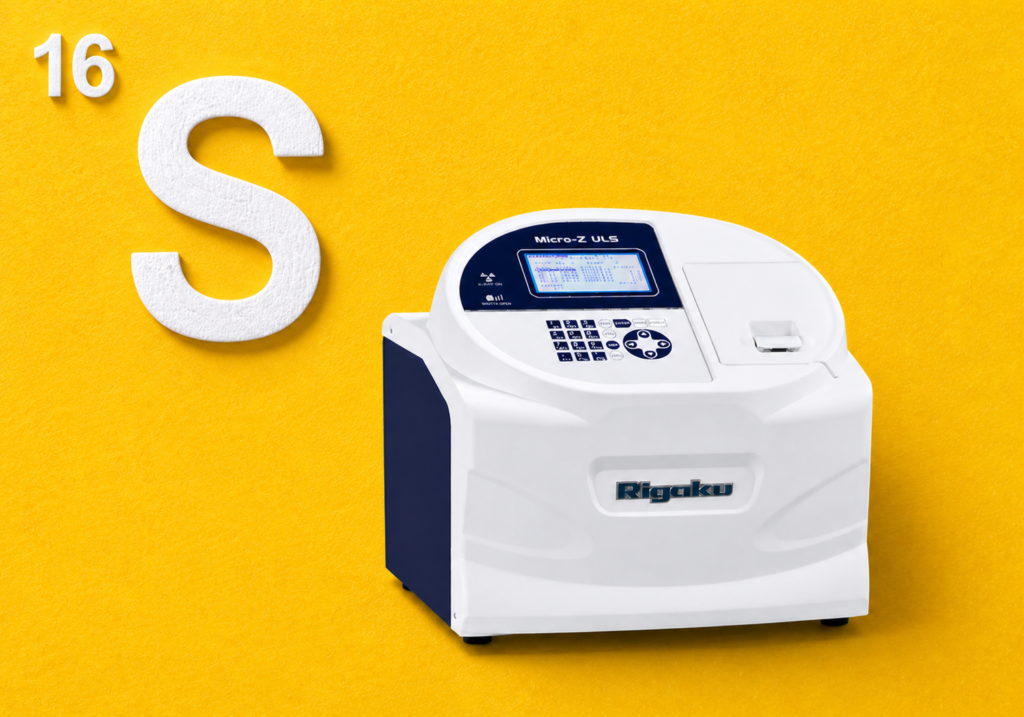
The Rigaku Micro-Z ULS Sulfur Analyzer meets all these metrics and is highly recommended for
RIGAKU Micro-Z ULS Sulfur Analyzer for D2622-16

The RIGAKU Micro-Z ULS benchtop WDXRF system represents a practical implementation of ASTM D2622-16 for ultra-low sulfur automotive fuels analysis.
Key features include:
• Fixed-geometry optics optimised specifically for sulfur detection
• Vacuum optical path eliminating helium requirements for reduced operational costs
• Air-cooled 40 W X-ray tube, reducing infrastructure needs
• Demonstrated compliance with ASTM D2622-16 repeatability criteria for diesel and gasoline
Such systems are well-suited for routine laboratory environments requiring reliable, high-precision sulfur analysis without complex installation requirements.
A copy of Rigaku WDXRF Application note #1083 – Analysis of Ultra Low Sulfur in Automotive Fuels According to ASTM D2622-16 by Sulfur Analyzer Micro-Z ULS can be issued upon request
Conclusion:
Ultra-low sulfur automotive fuels demand analytical techniques capable of delivering high sensitivity, precision, and regulatory compliance. ASTM D2622-16, implemented via benchtop WDXRF, remains a cornerstone method for sulfur analysis in UK fuel laboratories.
With appropriate calibration, quality control, and instrument selection, benchtop WD-XRF systems provide a robust and efficient solution for routine sulfur content determination, supporting compliance with stringent UK and European fuel specifications while maintaining operational efficiency.
What to do Next?
To ensure reliable, compliant ultra-low sulfur analysis in your laboratory, speak to our product specialists to assess whether benchtop WDXRF is the right fit for your workflow and explore the capabilities of the Rigaku Micro-Z ULS in your specific application.
Page FAQ's
ASTM D2622-16 using modern WDXRF systems can achieve detection limits down to approximately 0.3 mg/kg, making it suitable for ultra-low sulfur fuel analysis below 10 mg/kg.
Yes, WDXRF methods such as ASTM D2622-16 are applicable to a wide range of petroleum products, including diesel (EN 590) and petrol (EN 228), when appropriate calibration is used.
WDXRF offers higher spectral resolution, reducing interferences and improving accuracy at ultra-low sulfur levels, whereas EDXRF is typically more suited to higher concentration ranges or screening applications.
- No, many modern benchtop systems, such as the Rigaku Micro-Z ULS, use vacuum optics instead of helium, reducing operational costs and simplifying laboratory setup.
Contact Us Today
We take great pleasure in assisting you and ensuring you get a prompt response to your questions
Live chat opening hours Mon – Fri 9:15 to 16:30 (UK Time)