
SciMed Education
Understanding the Lithium‑Ion Battery Lifecycle – from Raw Materials to Recycling
Introduction
Lithium‑ion batteries rely on high‑quality raw materials and careful processing to deliver high performance and long life; analytical techniques such as inductively coupled plasma optical emission spectrometry (ICP‑OES), inductively coupled plasma mass spectrometry (ICP‑MS), atomic absorption spectrometry (AAS) and total organic carbon (TOC) analysis ensure the purity of starting materials, monitor.
What raw materials are used to make lithium‑ion batteries and why does their quality matter?
Lithium‑ion battery cells derive much of their value from the raw materials that make up the positive and negative electrodes, electrolyte and separator. Roughly 80 % of a cell’s value comes from raw materials, so the quality of ores and brines is crucial. Cathode materials can be formulated from salts such as nickel sulphate, manganese sulphate, cobalt sulphate and lithium carbonate/hydroxide; anodes typically use purified graphite.
These precursor chemicals must be “battery‑grade” with extremely low levels of impurities because contaminants reduce the active material content, catalyse side reactions and compromise safety. Analytical techniques such as ICP‑OES and ICP‑MS allow rapid multi‑element analysis of brines and ores despite high total dissolved solids and matrix interferences, while graphite purity is routinely assessed using ICP‑OES or ICP‑MS.

How does refinement and impurity control affect battery performance?
After mining, raw materials are refined into salts and powders that become cathode and anode materials. Controlling impurities in nickel and cobalt sulphate is critical because even trace levels of unwanted elements can reduce a battery’s lifetime by encouraging side reactions or damaging separators. High‑resolution ICP‑OES instruments provide the sensitivity and spectral resolution needed to distinguish desired elements from interfering species and quantify trace metals at sub‑µg L⁻¹ levels.
For organic impurities, total organic carbon (TOC) analysis quantifies carbon residues in salts and solvent mixtures, while total nitrogen bound (TNb) measurement indicates nitrogenous contaminants. The combined use of ICP‑OES, ICP‑MS and TOC/TNb analysis ensures that battery‑grade materials meet strict purity specifications before electrode fabrication.
What analytical techniques support the lithium‑ion battery lifecycle?
Analytical chemistry plays a central role in each stage of the battery value chain. In the upstream sector, brines and ores are complex mixtures with high total dissolved solids (TDS) and matrix effects that can skew results; sample preparation methods such as dilution or matrix matching are therefore essential. ICP‑OES offers multi‑element capability with good precision, but matrix suppression can limit its sensitivity at low trace levels. ICP‑MS provides greater sensitivity and is increasingly used when impurities must be measured in the ng L⁻¹ range. Atomic absorption spectrometry (AAS) remains useful for routine analysis but may reach sensitivity limits for certain elements.
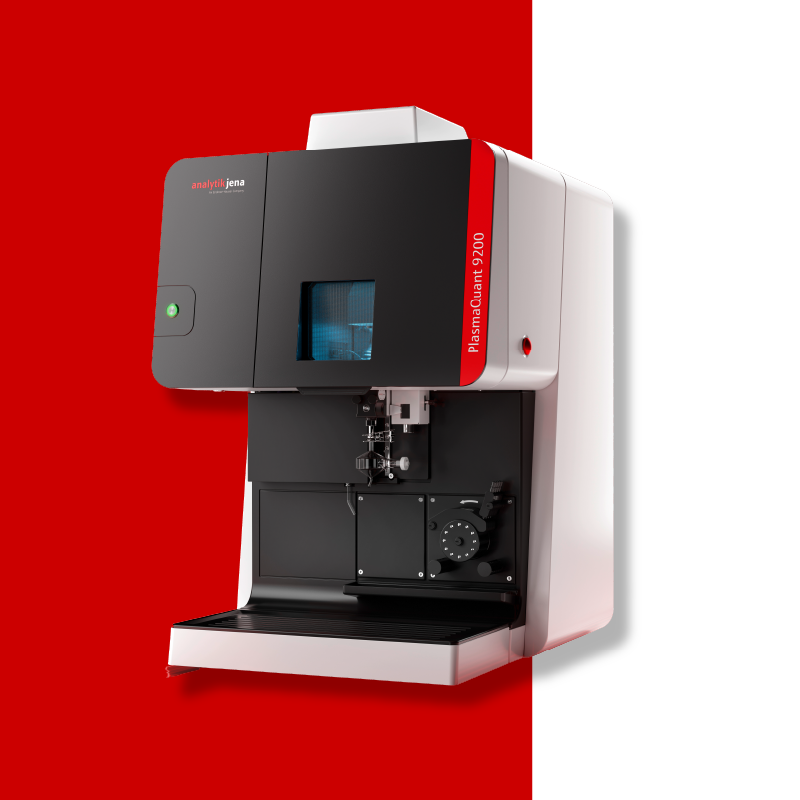
High‑performance instruments such as PlasmaQuant MS and contrAA high‑resolution AAS enhance detection limits and minimize spectral interference. In addition, TOC and TNb analyzers monitor organic solvents and slurries to ensure that carbon and nitrogen contamination stays within specification.
How is wastewater monitored during lithium‑ion battery production?
Battery production can generate wastewater containing heavy metals (nickel, cobalt, manganese) and organic solvents; strict regulations require accurate quantification before discharge. A combination of AAS, ICP‑OES and ICP‑MS is used to measure concentrations from mg L⁻¹ down to sub‑µg L⁻¹. TOC/TNb analysis assesses organic contaminants and nitrogen compounds in wastewater streams. Because manufacturing wastewaters often contain complex matrices, careful sample preparation—including acidification, dilution or separation—is necessary to obtain reliable results. Modern high‑resolution instruments help overcome interferences and ensure that discharges meet environmental standards.
How are spent lithium‑ion batteries recycled and what is black mass analysis?
The end‑of‑life stage of the lithium‑ion battery lifecycle involves dismantling and recycling. Spent batteries are shredded into a fine powder known as black mass, which contains graphite and metal oxides such as lithium, cobalt, copper, nickel and manganese. Recycling efficiency is mandated by European regulations (currently 50 %, rising to 65 % by 2025) so manufacturers must recover valuable metals and ensure the quality of recycled materials.
There are no universal guidelines for black mass sample preparation, but a typical approach involves extracting metals from the solid matrix using strong acids (e.g., HNO₃, HCl) and hydrogen peroxide, then analysing the digested solution with high‑resolution continuum source AAS (HR‑CS AAS). This method allows quantification of major components and trace impurities, enabling recyclers to adjust their processes and recover high‑purity metals for new battery production.
What is the outlook for lithium‑ion battery production and the energy transition?
Global lithium production increased dramatically—by around 335 % between 2008 and 2018—and reserves of lithium are estimated at approximately 14 million metric tons. As demand for electric vehicles and energy storage grows, sustainable production and recycling practices are critical. High‑purity raw materials and precise analytical control throughout the battery lifecycle will ensure consistent quality and safety while minimizing environmental impact. Instruments such as ICP‑OES, ICP‑MS, AAS and TOC/TNb analyzers provide the necessary precision and efficiency for this rapidly expanding industry.

What to do next?
Explore advanced instrumentation – SciMed offers a portfolio of high‑resolution ICP‑OES, ICP‑MS and TOC/TNb analyzers designed to meet the stringent requirements of lithium‑ion battery production and recycling. These instruments deliver exceptional sensitivity and interference control, ensuring accurate results even in complex matrices.
Discuss your application with our experts – Whether you need to analyse raw materials, monitor manufacturing effluent, or characterise black mass, SciMed’s technical specialists can recommend appropriate analytical techniques and instruments tailored to your specific needs.
Implement best practice in sample preparation – Achieving accurate results begins with proper sample digestion, dilution and matrix matching. Our team can advise on effective preparation methods and reagents to overcome matrix effects and achieve reliable quantification.
Page FAQ's
ICP‑OES (optical emission spectrometry) measures light emitted by excited atoms in a plasma and is suitable for multi‑element analysis at mg L⁻¹ to low µg L⁻¹ levels. ICP‑MS (mass spectrometry) detects ions by their mass and offers much lower detection limits, down to the ng L⁻¹ range. ICP‑MS therefore provides greater sensitivity but may require more advanced sample preparation and matrix matching.
Contaminants in nickel and cobalt salts can replace active metals in the crystal lattice, catalyse side reactions or damage separators. Even small amounts of impurities can shorten battery life and compromise safety, so high‑resolution ICP‑OES or ICP‑MS is used to detect trace contaminants.
Total organic carbon (TOC) analyzers quantify carbon residues in solvents, slurries and brines. When combined with total nitrogen bound (TNb) analysis, they provide a comprehensive assessment of organic and nitrogenous contaminants in battery‑grade materials and wastewater.
Black mass is the powder produced when spent lithium‑ion batteries are shredded and contains metals such as lithium, cobalt, nickel, manganese and copper mixed with graphite. It is digested with acids and analysed using HR‑CS AAS or other elemental techniques to determine the concentration of valuable metals and impurities, enabling efficient recycling.
Contact Us Today
We take great pleasure in assisting you and ensuring you get a prompt response to your questions
Live chat opening hours Mon – Fri 9:15 to 16:30 (UK Time)