
SciMed Education
What is Refractometry? Understanding How Refractive Index Measurements Work
Introduction
Refractometry is a simple, non‑destructive technique that uses a beam of light to measure how much a substance bends the light. By comparing the speed of light in a sample to its speed in a vacuum, the instrument reports a dimensionless number called the refractive index. This value is linked to sample composition, so refractometry becomes a fast way of checking purity and concentration.
What is refractometry and why measure refractive index?
Refractometry is the practice of measuring the refractive index of a material. Every material that interacts with light has a refractive index (often abbreviated RI), and this constant describes how fast light moves through that medium compared with vacuum . Measuring this number allows laboratories and production sites to characterise liquids and solids, determine the concentration of solutions and monitor purity . Because it relies on optical properties, refractometry can often provide results quickly without destroying the sample.
How does a refractometer measure the refractive index via the critical angle?
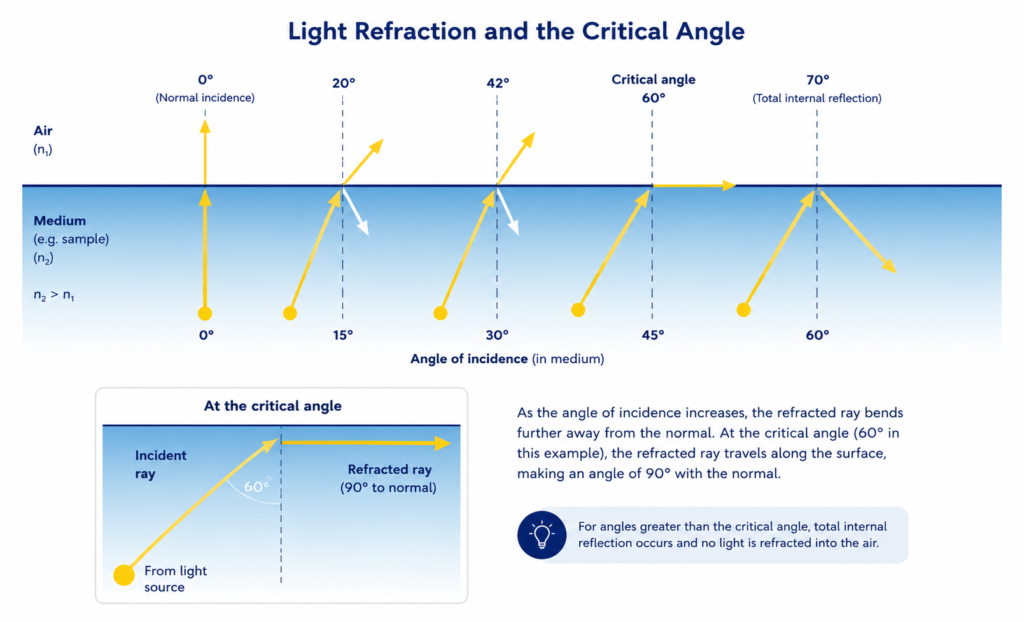
Modern refractometers work by shining a beam of light through a prism with a known refractive index toward the sample. Snell’s law states that light slows down when it moves into a more optically dense medium and speeds up when entering a less dense medium, causing the beam to bend at the interface. At a specific angle of incidence, no refraction into the second medium occurs and all light is reflected; this is known as the critical angle . By measuring this critical angle of total reflection and comparing it to the known refractive index of the prism, the refractive index of the sample can be calculated . In practice the instrument determines the angle where light intensity drops sharply, making refractometry both sensitive and reliable.
What are the key components of a refractometer?
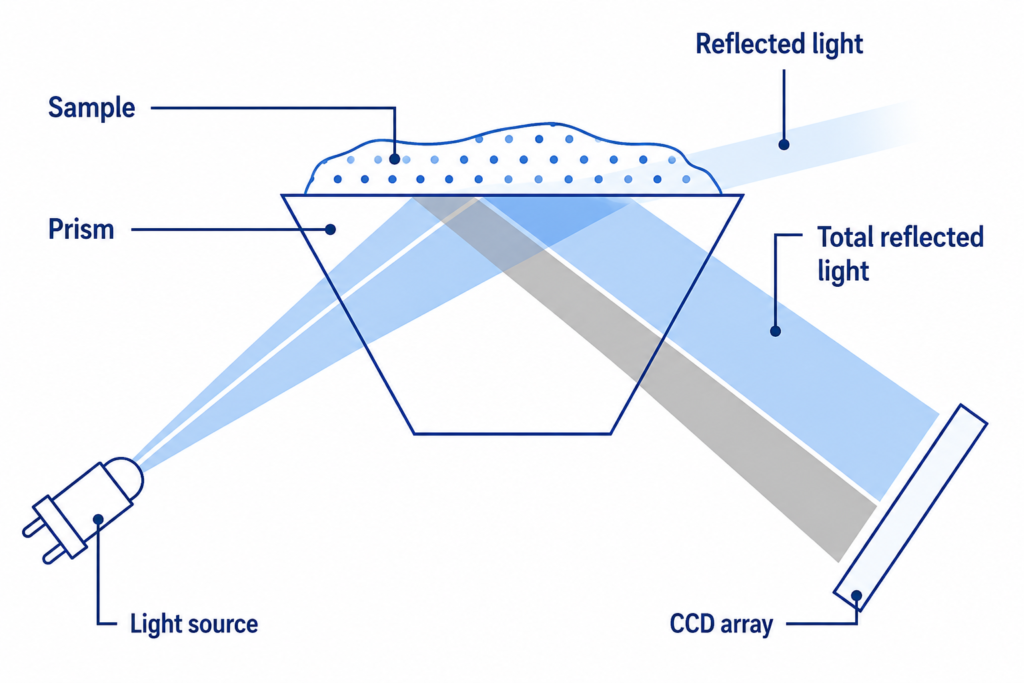
A typical critical‑angle refractometer contains a monochromatic light source (often filtered to 589 nm), a converging lens, a high‑refractive‑index prism, and a sensor. Light is directed towards the prism–sample interface at many angles; rays below the critical angle are refracted into the sample while those above it are totally reflected. A CCD detector measures the reflected light and pinpoints the exact angle at which total reflection occurs . Temperature control systems maintain both the prism and the sample at a constant temperature because refractive index varies with temperature .
How do wavelength and temperature affect refractive index?
Refractive index depends on wavelength, a phenomenon known as dispersion. For most materials the refractive index changes in a characteristic way across the visible and near‑infrared spectrum . Standard refractometry therefore uses a well‑defined wavelength – traditionally 589 nm, the sodium D‑line – and high‑precision filters. Temperature also plays a major role. Small changes in temperature alter the speed of light in both the prism and the sample, so accurate instruments use thermostatic water baths or Peltier elements to stabilise temperatures .
What are common scales and units in refractometry? – the Brix scale
The refractive index itself is a unitless ratio, but many industries use scales that convert refractive index to a convenient concentration value. The most widely known is the Brix scale, used to estimate the dissolved solids (mainly sugar) in juices, wine, honey and syrups. One degree Brix (°Bx) represents one gram of sucrose in 100 g of solution. Brix values are traditionally used in the wine, sugar, fruit‑juice and honey industries as well as in monitoring metalworking fluids . A refractometer converts the angle of refraction into a Brix value by using the established relationship between sugar concentration and refractive index; different solutes have different correlations, so calibration is important .
What are the main types of refractometers – Abbe, digital, interferometric and inline?
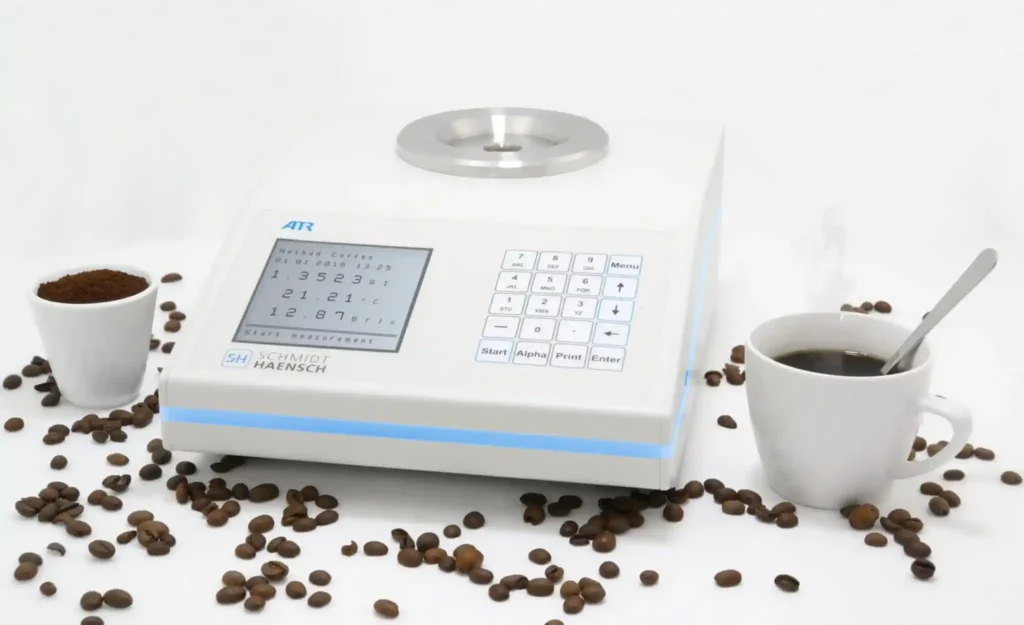
Many instrument designs exist to suit different tasks. Abbe refractometers use the principle of total internal reflection; a liquid sample is placed between two high‑index prisms and the maximum transmitted angle is observed through a microscope . Beam‑deflection refractometers measure how much a beam bends as it passes from a prism into the sample, using Snell’s law to calculate the refractive index . Interferometric refractometers exploit interference fringes to detect small changes in optical phase and are suited to differential measurements . Compact hand‑held refractometers provide quick field measurements, while bench‑top instruments offer high precision. Inline process refractometers are integrated into production lines to monitor refractive index continuously and provide real‑time process control .
What are the applications of refractometry in research and industry?
Because the refractive index reflects composition, refractometry has many uses. It is widely employed in research and industrial laboratories for quality control and product development . In the food and beverage sector it measures sugar content in juices, soft drinks, wine and honey; in the pharmaceutical industry it helps determine the concentration and purity of formulations. Refractometry is also used in evaluating scents and aromas and in online monitoring of food, beverage and pharmaceutical production . Beyond liquids, refractometers assist in mineral identification in geology and provide process feedback in chemical manufacturing. The technique’s versatility stems from the fact that many physical and chemical properties correlate with refractive index.
Why use refractometry for quality control and concentration measurements?
Measuring refractive index offers several advantages. It is rapid and requires only small sample volumes, allowing frequent checks during production. Since the technique compares light speeds, it is inherently nondestructive and can handle turbid or coloured samples. Modern instruments incorporate automatic temperature control and digital processing, delivering high precision even in harsh industrial environments . By linking refractive index to concentration or purity, refractometry enables producers to verify that raw materials and finished products meet specifications, making it a valuable tool for cost‑effective quality assurance .

What to do next?
If you need to measure the refractive index or Brix values of your products, SciMed offers a range of laboratory and process refractometers suitable for food, beverage, pharmaceutical and industrial applications. Our team can help you choose between Abbe, digital, hand‑held and inline instruments and advise on calibration and temperature control. Contact us today to discuss your application and receive a tailored quotation.
Page FAQ's
Refractometry is the measurement of a substance’s refractive index – the ratio of the speed of light in vacuum to its speed in the substance. This dimensionless number indicates how fast light travels through the sample and is used to infer concentration and purity.
Refractometers determine refractive index by shining a beam through a prism of known refractive index toward the sample and measuring the critical angle where light is totally reflected. Snell’s law relates this angle to the sample’s refractive index.
Refractive index varies with both wavelength (dispersion) and temperature. Standard measurements use a sodium D‑line wavelength of 589 nm and maintain sample and prism at a constant temperature; modern instruments often employ Peltier temperature control to ensure accuracy.
The Brix scale converts refractive index into a percentage of dissolved solids, usually sugar. One degree Brix represents 1 g of sucrose in 100 g of solution; it is commonly used in the wine, fruit juice, sugar and honey industries.
Contact Us Today
We take great pleasure in assisting you and ensuring you get a prompt response to your questions
Live chat opening hours Mon – Fri 9:15 to 16:30 (UK Time)