
Home » Products » Elemental Analysis » multi N/C 2300 TOC Analyser
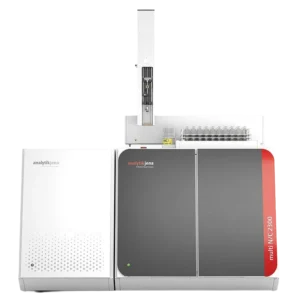
multi N/C 2300
TOC/TNb Analyser
Reliable direct injection TOC/TNb analysis for particle-rich, oily and small-volume samples — without making difficult matrices fit a conventional sample path.
Product Overview
Particle-loaded liquids, oily matrices and very limited sample volumes can expose the weaknesses in a long or restrictive sample-introduction route. The multi N/C 2300 uses a septum-free microlitre syringe to introduce the sample directly into the combustion tube.
This short route, combined with efficient rinsing, is designed to reduce blockage and carryover risk while helping more of the representative sample reach the measurement system.
Particle-loaded liquids, oily matrices and very limited sample volumes can expose the weaknesses in a long or restrictive sample-introduction route. The multi N/C 2300 uses a septum-free microlitre syringe to introduce the sample directly into the combustion tube.
This short route, combined with efficient rinsing, is designed to reduce blockage and carryover risk while helping more of the representative sample reach the measurement system.
Direct analysis of particle-rich and emulsion-like samples
Injection volumes from 10 to 500 µL
Broad TOC working range for many undiluted samples
Optional TNb, solids and automation configurations
Features & Benefits
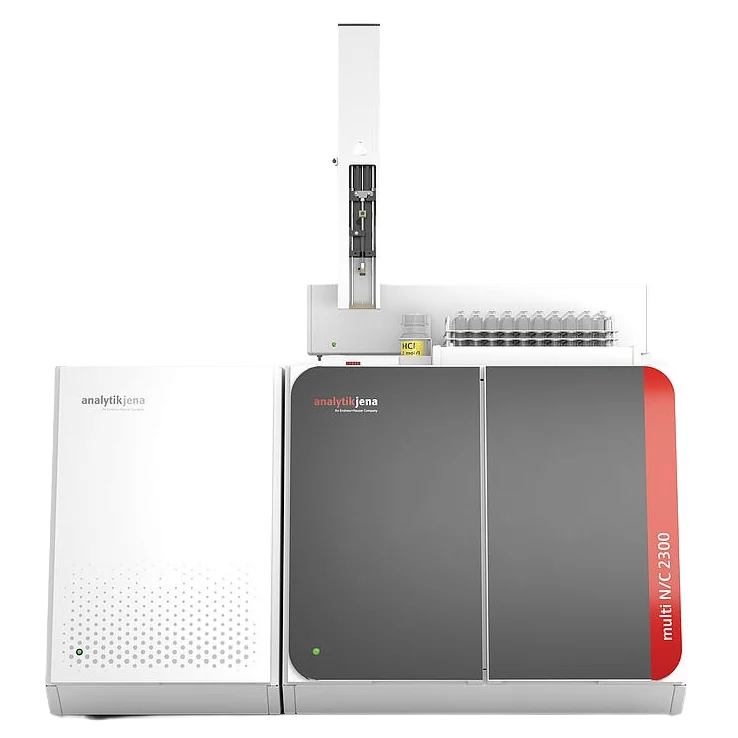
Direct sample injection
Septum-free/direct sample introduction
High-temperature TOC analysis
Core TOC analysis / broad sample capability
AS 60 automated sample handling
Automated liquid handling
Direct sample introduction
A septum-free route carries the sample from the microlitre syringe into the combustion tube, reducing places where particles can settle.
Small-volume analysis
Injection volumes from 10 to 500 µL support research and pharmaceutical workflows where sample quantity is limited.
Fewer dilution steps
A broad TOC range of up to 30,000 mg/L can make direct analysis possible for many samples that would otherwise require preparation.
Automated liquid handling
The AS 60 can automate acidification, purging and magnetic stirring to support more consistent liquid-sample workflows.
Flexible detection
Configure TOC analysis with optional ChD or CLD nitrogen detection to match environmental, industrial or pharmaceutical requirements.
Optional solids capability
Add manual or automated solids modules when the laboratory needs a combined liquid and solid TOC workflow.
multi N/C 2300: TOC/TNb analysis for particle-rich samples
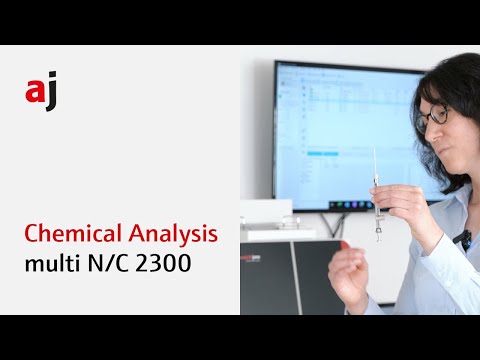
About the multi N/C 2300
Designed around demanding matrices.
The analyser combines catalytic high-temperature combustion with a wide-range focus-radiation NDIR detector. Easy Cal and VITA flow management support stable calibration and compensate for gas-flow fluctuations.
The base multi N/C 2300 is suited to environmental and research applications. ChD and CLD configurations extend the platform to simultaneous TOC/TNb work, while the multi N/C 2300 duo adds automated solids analysis.
10–500 µL
Injection volume
3–5 min
Typical measurement time
50 µg/L
TOC limit of detection
0–30,000 mg/L
TOC measurement range
Configurations at a Glance
The core configuration for particle-containing or oily liquids and small-volume environmental or research samples.
multi N/C 2300
- TOC, TC, TIC, DOC and NPOC methods
- Optional manual solids modules
- Optional CLD nitrogen module
Adds an integrated electrochemical detector for simultaneous carbon and total-bound-nitrogen measurement.
multi N/C 2300 ChD
- Compact integrated detector
- TNb range up to 100 mg/L
- Suitable for routine environmental work
Uses a chemiluminescence detector where greater TNb sensitivity or a wider nitrogen range is required.
multi N/C 2300
- TNb detection from 5 µg/L
- TNb range up to 200 mg/L
- Detector module can be added later
Combines direct-injection liquid analysis with automated high-temperature combustion for less homogeneous solid samples.
multi N/C 2300 duo
- Automated solids introduction
- HT 1300 ceramic combustion system
- Optional TIC and TNb capability
A dedicated CLD-based total-nitrogen configuration for aqueous protein solutions and selected vaccine quality-control workflows.
multi N/C 2300 N
- High automation for larger sequences
- 112-position HPLC-vial rack option
- Designed for low sample consumption
Extend the platform during initial specification or later as analytical requirements change.
Optional modules
- AS 60 liquid autosampler
- HT 1300 and double-furnace solids options
- Manual or automated TIC modules
Technical Data
| Configuration | Primary measurements | Detection | Published working range | Dimensions (W × D × H) |
|---|---|---|---|---|
| multi N/C 2300 | TC, TIC, TOC, DOC, NPOC | Focus-radiation NDIR | Carbon: 0–30,000 mg/L | 513 × 547 × 464 mm |
| multi N/C 2300 ChD | Carbon parameters + TNb | NDIR + electrochemical ChD | Carbon: 0–30,000 mg/L TNb: 0–100 mg/L | 513 × 547 × 464 mm |
| multi N/C 2300 CLD | Carbon parameters + TNb | NDIR + chemiluminescence | Carbon: 0–30,000 mg/L TNb: 0–200 mg/L | 813 × 547 × 464 mm |
| multi N/C 2300 duo | Liquid carbon + solids TOC/TC | NDIR; optional nitrogen detection | Liquid carbon: 0–30,000 mg/L Solid carbon: 0–100 wt-% | 1,865 × 650 × 970 mm |
| multi N/C 2300 N | Total nitrogen | Chemiluminescence | TN: 0–200 mg/L | 813 × 547 × 970 mm |
Liquid configurations use direct injection volumes of 10–500 µL, with typical published measurement times of 3–5 minutes and RSD precision of 2–3%. Technical suitability should be confirmed for the intended matrix, method and regulatory environment.
Software and data handling
multiWin pro keeps the sequence visible.
A single-screen operating environment for method control, live results, calibration and reporting.
- Live result updates within the sequence table
- Automatic calibration and Easy Cal multi-point calibration
- Result evaluation and reporting while a sequence is running
- Automatic self-diagnostics and maintenance monitoring
- Export to LIMS, CSV and PDF formats
- Optional FDA 21 CFR Part 11 data-integrity module
Published method compatibility
The series is associated with a broad group of recognised TOC, TN and solids methods. The exact instrument configuration and method setup must be matched to the laboratory requirement.
"Direct injection TOC analysis built for
particle-rich, oily and low-volume samples"
15% off
Special direct injection bundle
Available until 31 December 2026 while stocks last. Explore the campaign offer, then ask SciMed to confirm configuration, eligibility and commercial terms.
Product FAQ's
Its septum-free direct-injection route introduces the sample from a microlitre syringe straight into the combustion tube. The shorter route and rinsing technology are designed to reduce particle loss, blockage and carryover risk.
The published injection-volume range is 10 to 500 µL. The appropriate injection volume depends on the matrix, concentration and selected method.
Yes. Nitrogen detection can be configured using an integrated ChD detector or a CLD detector module. The final configuration should be confirmed with a SciMed specialist.
Optional manual solids modules are available, while the multi N/C 2300 duo provides an automated liquid-and-solids configuration.
Yes. The AS 60 offers automated sample introduction with acidification, purging and magnetic stirring for liquid samples.
Applications
Chemical & Materials
Contact Us Today
We take great pleasure in assisting you and ensuring you get a prompt response to your questions
Live chat opening hours Mon – Fri 9:15 to 16:30 (UK Time)
Request a Call Back
Please refer to our Privacy statement for information on how SciMed uses your details.
Back to Menu
